
Every year, corporate RFP season follows the same arc. Travel programs send out their RFPs over the summer and early fall, hotels answer them through the fall, and the accepted rates go live on January 1.
Most hotel sales teams treat the season as a deadline: get the responses in. But a corporate rate isn't won when the RFP is accepted. It's won when the rate is loaded, when a traveler can actually book it, and when it's renewed before a competitor takes the account. Those steps happen after the deadline everyone is watching, which is where most of the value leaks out.
This piece walks the corporate RFP year in order, from the invitation to the renewal, with what to do at each stage.
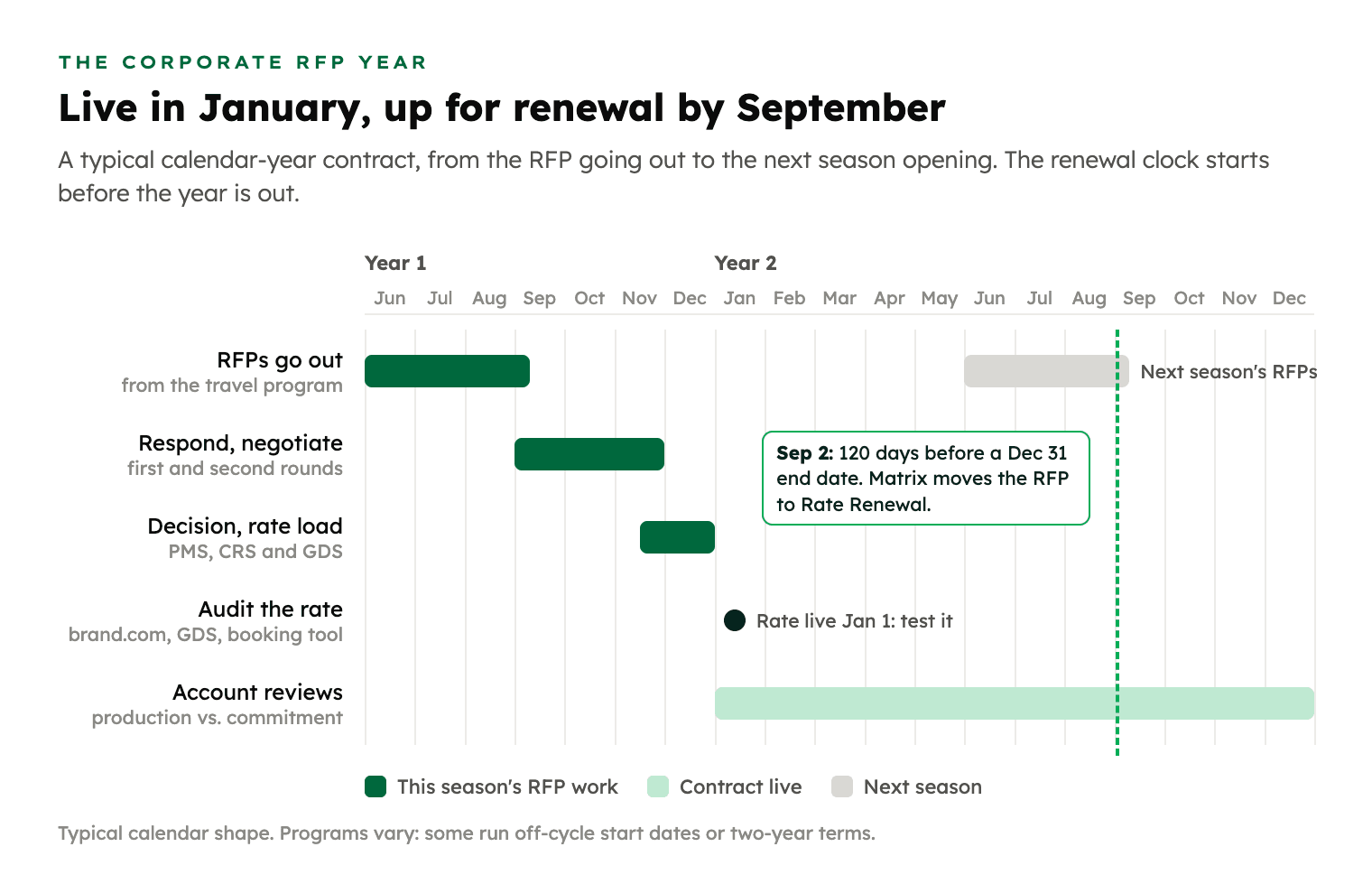
A typical calendar-year contract. Programs vary: some start on other dates or run two-year terms.
How the corporate RFP calendar works
A corporate travel program negotiates its hotel rates once a year, sometimes once every two years. The buyer, usually a travel manager or the program's travel management company, sends hotels an RFP listing the company's expected volume, the locations it needs, and the terms it wants.
Many of those RFPs arrive through a sourcing platform. A common one is Cvent's transient platform, which many hotel teams still call Lanyon, after the company Cvent combined with in 2016. Others come through the program's own tools or by email. Many programs build their questions on the GBTA's standard hotel RFP template, so the questions look familiar from one RFP to the next.
The shape of the year is consistent:
- RFPs go out between early summer and early fall.
- Hotels respond and negotiate through the fall, often in more than one round.
- Decisions come back late in the year, and accepted rates are loaded for January 1.
Not every program runs on the calendar year. Contracts that start on April 1 or July 1 exist, as do two-year deals. Track each contract's own start and end dates rather than assuming the season.
Stage 1: Build the business case before you bid
The decision to bid starts with what the account has done for you. What did it produce last year at this hotel, and at the others in your portfolio? Did it deliver the room nights it committed to, at the rate you agreed? An account that promised 1,200 nights and delivered 500 is a different bid from one that came in ahead. Hotel account production covers how to measure that month by month.
Not every RFP deserves a full response. Some programs send RFPs to every hotel in a market to check prices, with no real intent to move business. Qualifying them first saves the effort for the ones you can win. The framework in hotel RFP lead qualification is written for group RFPs, but its questions about intent and fit carry over.
Stage 2: Price the response
Two decisions shape most corporate rates, and they're independent of each other.
Fixed or dynamic. A fixed rate is one price for the year. A dynamic rate is a percentage off the best available rate (BAR), so it moves with demand. Fixed rates give the buyer a number to budget against and give you a rate you can plan around. Dynamic rates protect you on high-demand nights but give the buyer less certainty. Many hotels offer fixed rates to their biggest accounts and dynamic rates to everyone else.
LRA or non-LRA. LRA, last room availability, means the rate has to be offered as long as you have a room of that type left to sell. Non-LRA lets you close the rate on your busiest nights. Buyers value LRA because their travelers can always book the rate, and it usually costs them something in the discount. Either a fixed or a dynamic rate can be LRA or non-LRA.
Then there's everything else that goes into the price: breakfast, Wi-Fi, parking, the cancellation window, blackout dates and room type. Two rates with the same number can be worth very different amounts once those terms are included.
Price from the account's actual pattern, not its hopes. If its travelers stay Monday to Wednesday in your busiest months, an LRA rate costs you more than it would for an account that fills your soft weekends. How to analyze historical hotel rates covers reading that pattern without drowning in noise.
Stage 3: Submit, then expect a second round
Many programs run more than one round. The buyer narrows the list, comes back with a counter-offer, or asks for a better rate on a specific property. Keep a record of what you offered and when, so the second-round answer is consistent with the first.
There are three outcomes. Your rate is accepted and your hotel is preferred, or it's declined, or it lands in between: negotiated but not preferred. That means the program accepts your rate and travelers can book it, but your hotel isn't listed as preferred and travelers aren't steered to you. It's still a rate to load, audit and track. It just carries less volume.
To see how your RFPs are converting across the season, the response rate, win rate and response time are covered in the hotel RFP process and the metrics that track it. And if your win rate is low, why hotel RFP responses fail is a good place to start.
Stage 4: Accepted isn't loaded
Once a rate is accepted, it has to be loaded under the right rate code in the hotel's systems and distributed to the GDS before the program's start date. Usually that's a handoff from sales to the revenue manager or a brand coordinator. That handoff is where rates go missing: a request sits in an inbox, a rate code gets mistyped, or the start date slips past January 1.
Treat the handoff as a task with an owner and a date, not an email you hope gets read.
Stage 5: Loaded isn't bookable
A rate that's loaded but can't be booked produces nothing, and nobody tells you. The traveler just books somewhere else. So check it the way a traveler will see it:
- Test sell on the brand website. Can the rate be found and booked?
- A GDS screenshot from the travel agent. Does the rate show where agents book?
- A screenshot from the client's online booking tool. Many corporate travelers never see anything else.
- The booking link. If the account has one, does it still work?
Do this in January, as soon as the rate is live, and check the booking link again during the year.
Stage 6: Keep the account warm through the year
Once the rate is live, schedule account reviews and client visits, with more of them for higher-volume accounts. Track the account's production against its commitment every month, not only at renewal. An account that's running behind in March is a conversation to have in March, while there's still time to find out why.
Stage 7: Renewal starts about four months out
For a calendar-year contract, the next RFP season opens around September, while the current rate still has four months to run. That's when the renewal decision needs to start: is the account worth keeping at this rate, worth renegotiating, or worth letting go?
The audit for that decision is in how to audit your negotiated accounts before renewal season. If you don't renew, make sure the rate actually comes out of availability, or travelers can keep booking an expired rate.
How Matrix runs the RFP year
Matrix tracks corporate RFPs on their own board, with a stage for each step of the year: Prospect, Business Case Submitted, RFP Submitted, Rate Loading, Definite, Rate Renewal and Negotiated But Not Preferred. Each card shows the account, the property, the contract dates and the value, along with whether the rate is fixed or a percentage discount.
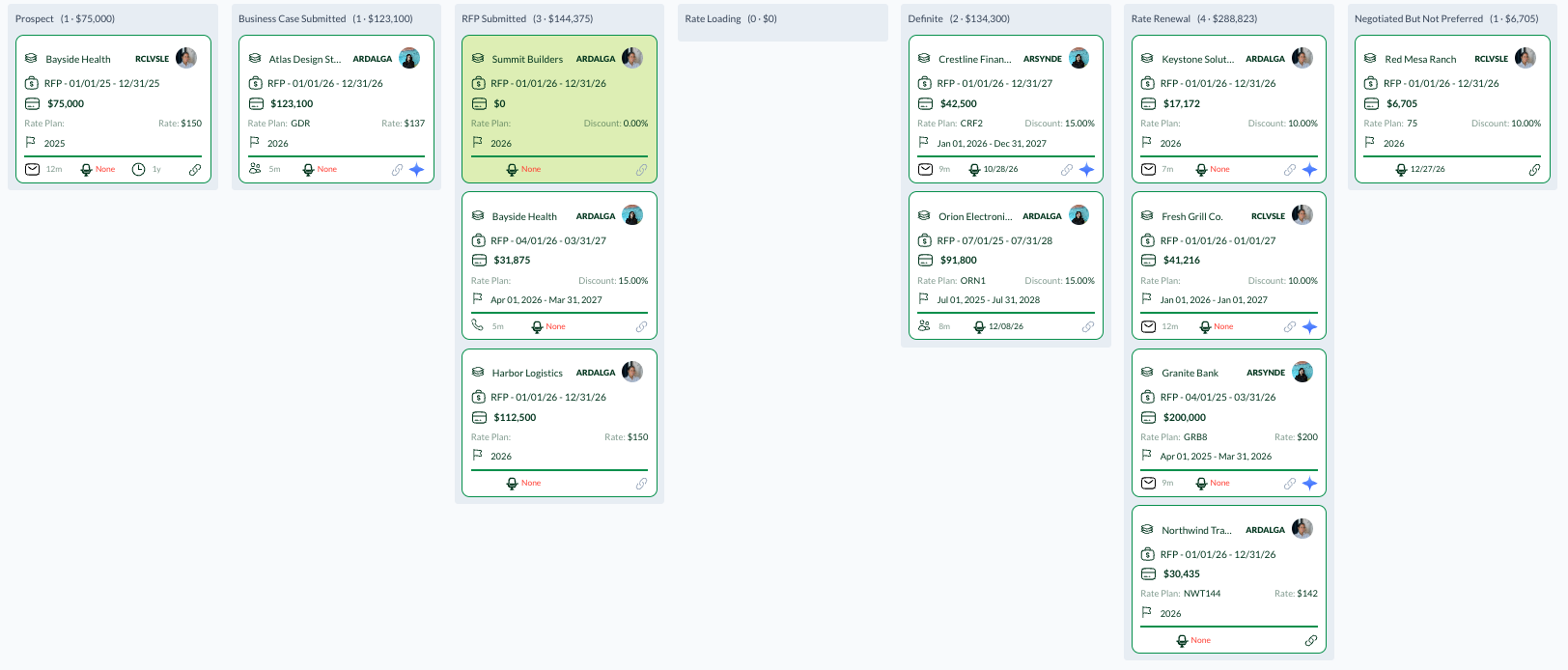
The RFP board. Demo data, with account names changed. Select the image to open it full size.
Several of the steps above are built in:
- Rate loading. A Rate Load Request, sent from the opportunity, gathers the rate details and emails them to the people you choose, such as the revenue manager or a brand coordinator. Sending it moves the opportunity to Rate Loading.
- The audit. When a rate reaches Definite, Matrix creates the audit tasks as activities: a brand test sell, the GDS and online booking tool screenshots, and booking link audits through the year. The full list is in auto activities.
- Account reviews. Recurring review activities are scheduled from the opportunity, more often for higher-volume accounts, and monthly production sits on the contract next to what was promised.
- Renewal. A Definite RFP moves to Rate Renewal automatically 120 days before its end date. For a December 31 contract, that's September 2, right as the next season opens. Renew by cloning the opportunity rather than editing it, so last year's record stays intact. See rate renewals.
- Removing the rate. If an opportunity moves to Closed or Lost without being renewed, Matrix creates a reminder to contact the revenue manager to take the rate out of availability.
The same contracts run through the business travel and RFP pipeline, alongside the LNRs your sellers negotiate directly.
Frequently asked questions
When is hotel RFP season? For most corporate travel programs, RFPs go out between early summer and early fall, hotels respond and negotiate through the fall, and accepted rates are loaded for a January 1 start. Not every program follows that calendar. Some contracts start on other dates, such as April 1 or July 1, and some run for two years, so track each contract's own dates rather than assuming the season.
What is the difference between LRA and non-LRA corporate rates? LRA stands for last room availability. An LRA rate has to be offered as long as the hotel has any room of that type left to sell. A non-LRA rate lets the hotel close the negotiated rate on high-demand dates. Buyers value LRA because their travelers can always book the rate, so it usually costs them something in the discount. LRA is separate from whether the rate is fixed or dynamic: either kind can be LRA or non-LRA.
Should a hotel offer a fixed or a dynamic corporate rate? A fixed rate is one price for the year, which gives the buyer predictability and gives the hotel a rate it can plan around. A dynamic rate is a percentage off the best available rate, so it rises and falls with demand. Many hotels offer fixed rates to their highest-volume accounts and dynamic rates to the rest. The right answer depends on the account's volume, when its travelers stay, and how often those nights sell out.
What does negotiated but not preferred mean? It's an outcome between winning and losing. The travel program accepts your rate and it gets loaded, so its travelers can book it, but your hotel isn't listed as a preferred property. Travelers aren't steered to you, so the volume is usually lower than the RFP suggested. It's still a rate to load, audit and track.
What happens after a corporate RFP is accepted? The rate has to be loaded under the right rate code in the hotel's systems and distributed to the GDS before the program's start date. Then it should be checked the way a traveler will see it: a test booking on the brand website, a screenshot from the travel agent's GDS, and a screenshot from the client's online booking tool. An accepted rate that isn't bookable produces no business.
When should a hotel start renewing a corporate rate? About four months before the contract ends. For a calendar-year contract that's early September, which is when the next RFP season is already under way. Starting at that point gives you time to review the account's production, decide whether to renew, and respond to the next RFP before the deadline.