
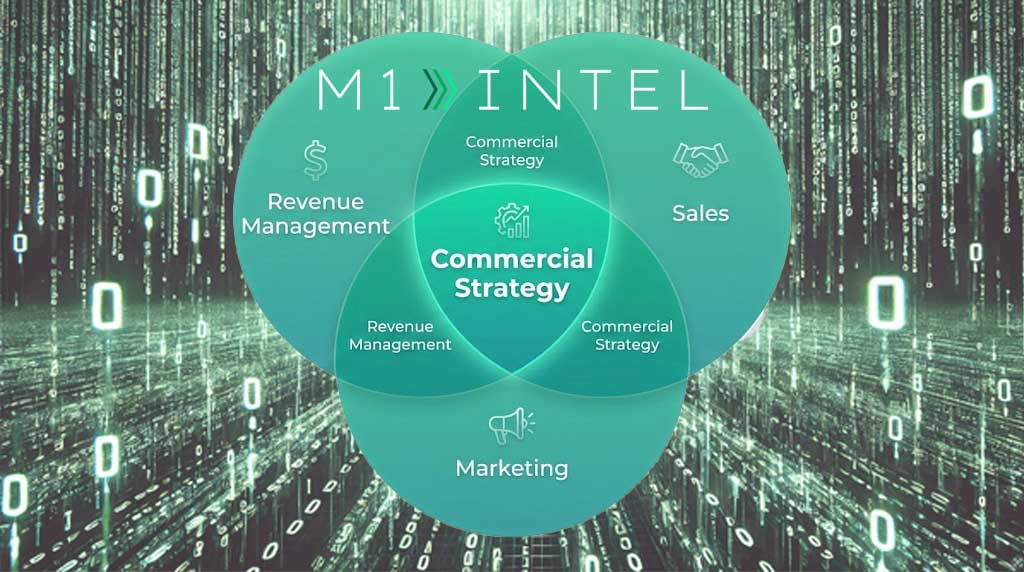
Hotel revenue strategy for management companies isn’t just a scaled-up version of what works at a single property. It’s a different discipline, one that requires consistent data, aligned processes, and the right infrastructure across every hotel in your portfolio. Revenue strategy is one pillar of a broader hotel commercial strategy that aligns revenue, sales, and marketing as one function.
This checklist is built for operators who are responsible for multiple hotels. It covers the foundational elements of a functioning revenue strategy: from how group and transient sales interact, to how pipeline data flows to revenue management, to the technology that makes portfolio-level visibility possible.
Use it as a diagnostic tool. Check off what you have. Flag what you don’t. The gaps you find are where revenue is slipping through.
Section 1: Revenue strategy foundations
- Defined segment mix targets by property. Each hotel should have explicit targets for transient, group, and contract segments, not just total occupancy and RevPAR goals. Without segment targets, revenue management decisions lack a strategic anchor.
- Group contribution benchmarks established. Know what percentage of total room revenue should come from group business at each property. Properties with high meeting space capacity and corporate demand should have different benchmarks than limited-service hotels.
- Displacement analysis process documented. When a group lead arrives, who runs displacement? What data do they need? How long should it take? If this process is ad hoc, profitable transient business is being given away and marginally profitable groups are being accepted.
- Pricing authority clearly assigned. Who can override rack rates for group bids? What approval threshold triggers a director-level review? Ambiguous pricing authority creates both revenue leakage and internal conflict.
- Competitive set defined and reviewed quarterly. Your comp set should reflect where group buyers actually compare you, not where you’ve always been benchmarked. For management companies, comp sets may differ significantly across properties.
Section 2: Group sales and pipeline management
This is where most management companies have the most room to improve. A well-documented hotel group sales and revenue management process requires:
- Standardized pipeline stages across all properties. “Prospect,” “Proposal Sent,” “Contract Out,” and “Closed” need to mean the same thing at every hotel. If stage definitions vary, portfolio-level pipeline reporting is meaningless.
- Probability weighting applied consistently. Each pipeline stage should carry a standard close probability that rolls up into a weighted pipeline value. This feeds revenue forecasts with group intelligence instead of guesswork.
- Sales activity logged in a shared CRM. Calls, emails, site visits, proposals, all of it should be in a single system accessible to both the property sales team and corporate oversight. Spreadsheets don’t scale across multiple hotels.
- Lost business tracking in place. Every deal that leaves the pipeline should be tagged with a reason: lost to competitor, rate objection, dates conflict, no decision, budget cut. This is the data that sharpens pricing and qualifies leads better next cycle.
- Group pace reviewed weekly at the portfolio level. Pace vs. same time last year, by property and in aggregate. This is your earliest signal for where group demand is building or lagging, and it should be visible to corporate revenue leadership without requiring a manual pull.
Tracking the right hotel sales KPIs for management companies is the foundation for executing this section. If you’re not measuring it, you can’t manage it across a portfolio.
Section 3: Revenue management and sales alignment
- Revenue management has real-time pipeline visibility. Revenue managers should be able to see active group leads, their stage, expected room nights, and arrival dates without waiting for a report. This visibility prevents forecast errors and enables proactive displacement decisions.
- Tentative holds are visible in the inventory system. When a group lead moves past first inquiry, the associated room block and function space should be visible to revenue management, even before it’s confirmed. This prevents double-booking scenarios and informs transient pricing in real time.
- Weekly alignment meeting between sales and revenue. Not to share information that should already be in a shared system, but to make decisions: Which leads need displacement analysis? Which should be prioritized? Which dates are at risk of overselling transient?
- 30/60/90-day group forecast includes pipeline probability. Your forward group forecast shouldn’t just show confirmed business. It should weight pipeline leads by close probability and surface the resulting range to revenue management. This closes the gap between what’s certain and what’s possible.
- Post-stay group performance reviewed. Did the group produce the room nights they contracted? How did their F&B and ancillary spend compare to forecast? This data improves future group pricing and helps sales qualify accounts more accurately.
Section 4: Technology and data infrastructure
A hotel revenue strategy is only as good as the data infrastructure underneath it. For management companies, this is non-negotiable:
- Single CRM used across all properties. Portfolio-level visibility, standardized reporting, and corporate oversight all require a single system. Multiple property-level tools create data silos and make portfolio management impossible at scale.
- CRM integrates with PMS at each property. Group bookings that close in the CRM should flow automatically into the PMS. Manual re-entry creates errors and delays, and in a fast-moving group sales environment, delays cost deals.
- Dashboards available to corporate leadership without property-level logins. Directors of sales, VPs of revenue, and ownership groups should be able to see portfolio pipeline, pace, and performance at a glance. If they need to ask a property GM for a report, the infrastructure is broken.
- Data retention policy covers at least 24 months. Pace analysis requires historical comparison. Two years of booking window, pipeline, and conversion data is the minimum needed to identify seasonal patterns and build reliable forecasts.
- User roles and access controls match the org structure. Property sales reps should see their own pipeline. GMs should see their hotel. Corporate oversight should see everything. A hotel CRM for sales teams and management companies should enforce this without requiring IT configuration for every hire or role change.
Section 5: Performance accountability
- Revenue goals set at the segment level, not just total RevPAR. Holding GMs accountable to total RevPAR without segment-level targets makes it impossible to diagnose where performance is breaking down. Set group room revenue targets, group pickup pace targets, and transient ADR targets separately.
- Sales team activity metrics tracked monthly. Calls made, proposals sent, site tours hosted, deals closed. Activity metrics don’t replace outcome metrics, but they identify whether underperformance is a pipeline volume problem or a conversion problem.
- CRM adoption monitored at the property level. If a property’s sales team isn’t logging activity consistently, their pipeline data is unreliable. Corporate leadership should be able to see CRM usage rates, not just pipeline totals, for each property.
- Annual strategy review tied to actual vs. forecast performance. At the end of each year, compare your group revenue forecast accuracy, displacement decisions, and pipeline conversion rates to your targets. The gap between plan and actual is the input for next year’s strategy.
Where most management companies fall short
When we look at the checklist above, the sections that consistently show the most gaps aren’t the strategy sections, they’re the infrastructure sections. Management companies often have the right goals and the right people. What they lack is a shared system that makes those goals visible and measurable across every property.
The the group and B2B CRM comparison does more than track leads. It creates the data layer that connects group sales activity to revenue management decisions, at the property level and at the portfolio level. Without it, even the best revenue strategy stays theoretical.