
Most hotels run sales on tools that were built for something else. The reservation system runs operations. The brand-supplied tool covers a slice of the workflow. The rest lives in spreadsheets, inboxes, and a sales coordinator's memory. It works until the portfolio grows, the volume climbs, and the gaps start costing real business.
A hotel sales management system is the software built specifically for the sales side of that work. This guide covers what it is, how it differs from a PMS and a guest CRM, the core functions it should cover, and what changes when you run sales across a multi-property portfolio. For the wider platform view, this page supports our pillar on hotel sales software for management companies.
What is a hotel sales management system?
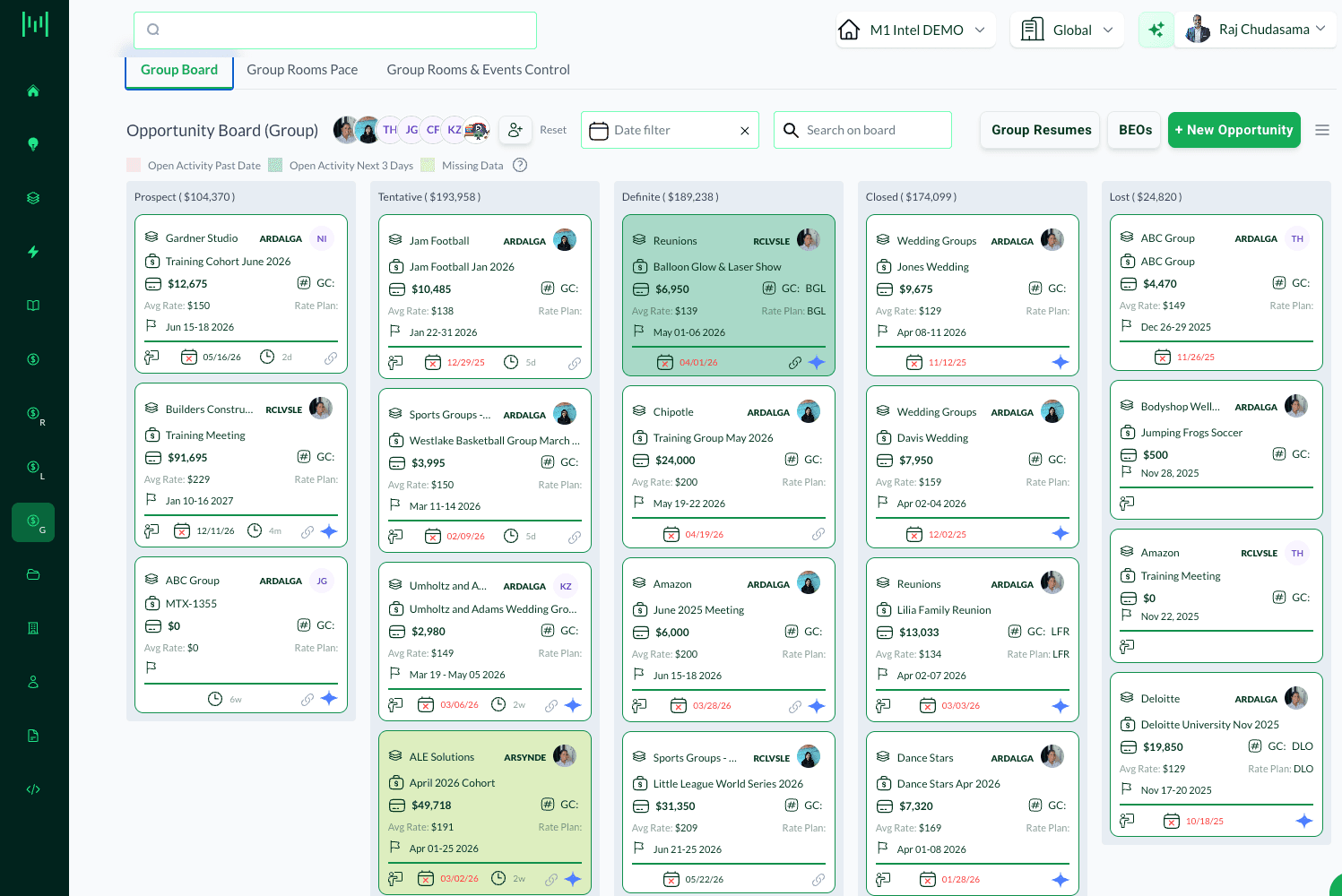
A hotel sales management system is the platform a hotel sales team uses to run B2B sales from first inquiry to booked production. Its core objects are leads, opportunities, and corporate accounts. Its core jobs are capturing group and corporate leads, managing the pipeline through defined stages, tracking RFP response, recording account production, logging activity, and reporting to sales leadership and ownership.
The user is the sales team: the director of sales and marketing, the group sales manager, the sales coordinator, and the regional or corporate director above them. The goal is to win more group and corporate business and to give leadership a clear, current view of the pipeline that produces it. A sales management system is also called a hotel sales CRM, though the strongest tools go past basic CRM record-keeping into pipeline intelligence and reporting.
Sales management system vs. PMS
The most common confusion is between the sales management system and the property management system, because both are core hotel software and both touch bookings.
A PMS runs operations: reservations, room inventory, rates loaded for transient, check-in and check-out, folio and billing, housekeeping status. It's the operational record of the hotel. A sales management system runs the commercial pursuit that happens before a group becomes a reservation: the RFP, the proposal, the negotiation, the group block held on tentative, the corporate rate agreement. The PMS records what is booked. The sales management system manages what is being sold.
They integrate, and they should, but they serve different teams. The front desk and revenue team live in the PMS. The sales team lives in the sales management system. Running group sales out of a PMS is like running the kitchen out of the reservation book: the tool wasn't built for that job.
Sales management system vs. guest CRM
The second confusion is with the guest CRM, because both get called a hotel CRM. A guest CRM manages individual travelers for marketing and loyalty: profiles, stay history, email campaigns, direct-booking promotions. Its user is the marketing or revenue team. A sales management system manages B2B sales: group leads, RFPs, corporate accounts, pipeline. Its user is the sales team.
The two share almost no workflow. A guest CRM has no concept of a group opportunity moving from tentative to definite, or an RFP win rate, or account production by corporate client. We cover this distinction in full in hotel sales CRM vs. guest CRM, because buying the wrong category is one of the most common and expensive mistakes a hotel sales team makes.
Core functions of a hotel sales management system
Strip it down and a hotel sales management system needs to cover five things well.
Lead and RFP intake
Group and corporate leads arrive from Cvent, MeetingBroker, brand referrals, and direct email. The system has to capture every inquiry, attach it to an account, and start the clock on response time. RFP response speed is one of the strongest predictors of winning the business, which is why we track it on its own lead response time page.
Group pipeline management
The center of the system. Opportunities move through defined stages, from inquiry to tentative to definite, each carrying value, room nights, and arrival dates. The team needs the whole pipeline visible at a glance, sortable by stage and value, with stalled deals easy to spot. The metrics behind this are detailed in hotel group sales pipeline metrics.
Account production
Corporate accounts, LNR agreements, and repeat group clients are the book of business. The system tracks production by account over time and flags accounts trending down before a renewal conversation, so the team manages the relationship instead of reacting to it.
Activity management
Calls, emails, site visits, proposals. The system logs the work against the account and opportunity so the pipeline reflects reality and managers can see where effort is going. Activity without outcomes is noise; the system should connect the two.
Ownership reporting
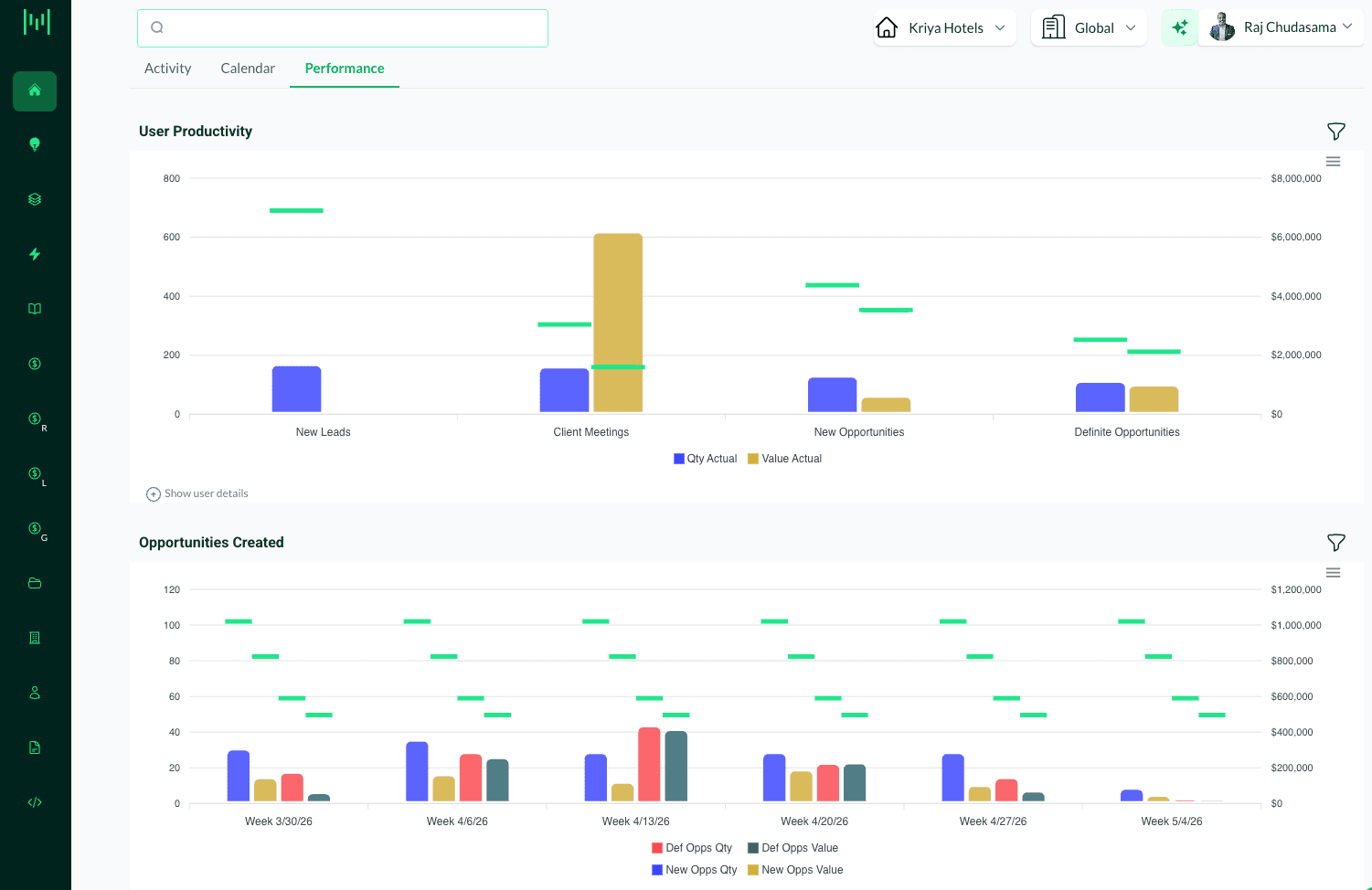
Sales leadership and ownership want a regular report: pace versus last year, pipeline value, RFP conversion, production by property. The system should generate it, not require a manual rebuild every week. The full reporting workflow is covered in automated ownership reporting for hotel management companies.
What changes at multi-property scale
For a single property, a sales management system is a convenience. For a management company, it's the difference between seeing the sales operation and guessing at it.
At portfolio scale, three things change. First, reporting has to roll up: ownership wants one portfolio view, not twelve property reports stitched together in a spreadsheet. Second, leads have to route across properties: an inquiry that fits three of your hotels needs to reach the right seller without dying in a shared inbox, the problem we cover in cross-property lead routing. Third, the data has to be standardized: every property using the same stages and definitions, so a portfolio comparison is comparing like with like.
Single-property tools can't do any of this, because their data model assumes one property. A management company running them ends up with a corporate analyst whose job is consolidating reports by hand. That role is the tell that the system isn't built for the portfolio.
Where Matrix fits
Matrix is the sales intelligence layer for hotels, built as a hotel sales management system for operators and management companies. It covers the five core functions by default, and because accounts, opportunities, and reporting live at the portfolio level, the multi-property capabilities are built in rather than bolted on.
For a single property, Matrix runs the full sales workflow: lead and RFP intake, group pipeline, account production, activity, and reporting. For a management company, it adds the portfolio layer: cross-property routing, rolled-up pipeline and production, and ownership reporting generated from the live data. It comes from operators running portfolio sales, not from a vendor adapting a PMS or a guest CRM, and the hotel sales workflows ship by default so the team is operational in weeks. Pricing is per-property, not per-seat. See the Matrix product page, current pricing, or book a demo below.
Frequently asked questions
Related resources
For deeper coverage of the topics in this guide:
- Hotel sales software for management companies. The pillar this page supports.
- Hotel sales CRM vs. guest CRM. The category distinction that trips up most buyers.
- Hotel B2B CRM for sales teams and management companies. The Matrix product view.
- Hotel group sales pipeline metrics. The metrics a sales management system should track.
- Top hotel sales management tools. The wider category map.
What is a hotel sales management system? A hotel sales management system is the software a hotel sales team uses to run B2B sales: capturing leads and RFPs, managing the group and corporate pipeline through defined stages, tracking account production, logging sales activity, and reporting to leadership and ownership. It's distinct from a PMS, which runs reservations and operations, and from a guest CRM, which runs marketing and loyalty. The sales management system is built around the seller's workflow, not the front desk or the marketing team.
How is a hotel sales management system different from a PMS? A PMS (property management system) runs the operational side of the hotel: reservations, room inventory, check-in, billing, housekeeping. A sales management system runs the commercial pursuit of group and corporate business before it ever becomes a reservation: the RFP, the negotiation, the group block, the account relationship. The PMS records what's booked; the sales management system manages what's being sold. They integrate, but they serve different teams and different stages.
Is a hotel sales management system the same as a guest CRM? No. A guest CRM manages individual travelers for marketing and loyalty. A sales management system manages B2B sales: group leads, RFPs, corporate accounts, and pipeline. Both get called a hotel CRM, which causes a lot of confusion when sales teams are buying. See our breakdown of hotel sales CRM vs. guest CRM for the full distinction.
What does a hotel sales management system do for a management company? At multi-property scale, it does something single-property tools can't: roll every property's pipeline, accounts, and production into one portfolio view, route leads across properties, and generate ownership reporting without manual consolidation. For a management company, the value is above-property visibility and accountability — seeing the whole sales operation in one place instead of stitching property reports together by hand.
How long does it take to roll out a hotel sales management system? A purpose-built hotel sales system that ships the workflows by default (group pipeline, RFP stages, account production, reporting) can be operational in weeks. A generic CRM configured for hotel sales takes longer because every workflow has to be built and maintained. For a multi-property portfolio, the main setup work is importing historical opportunities and standardizing stages across properties, usually a matter of weeks, not quarters.