
Search "hotel CRM" and almost every result answers a question hotel sales teams aren't asking. The guides rank guest profiles, loyalty programs, email segmentation, and direct-booking campaigns. That's real software solving a real problem, but it's the marketing team's problem. The director of sales trying to track a group lead from RFP to signed contract reads those guides and finds nothing that fits how they work.
The confusion is built into the words. Two completely different tools both get called a hotel CRM. This guide separates them: what a guest CRM does, what a hotel sales CRM does, why the mix-up costs sales teams real money, and what a hotel sales team (especially at a management company) actually needs. For the platform-level view, this page supports our pillar on hotel sales software for management companies.
Two different tools called hotel CRM
The phrase "hotel CRM" covers two product categories that share almost no workflow. Sorting them out is the whole point of this page.
What a guest CRM does
A guest CRM manages the relationship with the individual traveler. Its core objects are guest profiles, stay history, and preferences. Its core jobs are loyalty program management, email and SMS marketing, segmentation, pre-arrival and post-stay messaging, and direct-booking campaigns that pull demand away from the OTAs. Cendyn, Revinate, and the CRM modules inside platforms like Mews and Cloudbeds live here. The user is the marketing team or the revenue team, and the goal is more direct bookings and higher guest lifetime value.
This is valuable software. It's just built for a buyer who isn't the sales team.
What a hotel sales CRM does
A hotel sales CRM manages B2B sales. Its core objects are leads, opportunities, and corporate accounts, not guest profiles. Its core jobs are group lead intake, RFP response and tracking, opportunity pipeline management through defined stages, corporate and LNR account production, and reporting to sales leadership and ownership. The user is the sales team: the director of sales and marketing, the group sales manager, the sales coordinator, and the regional or corporate director above them.
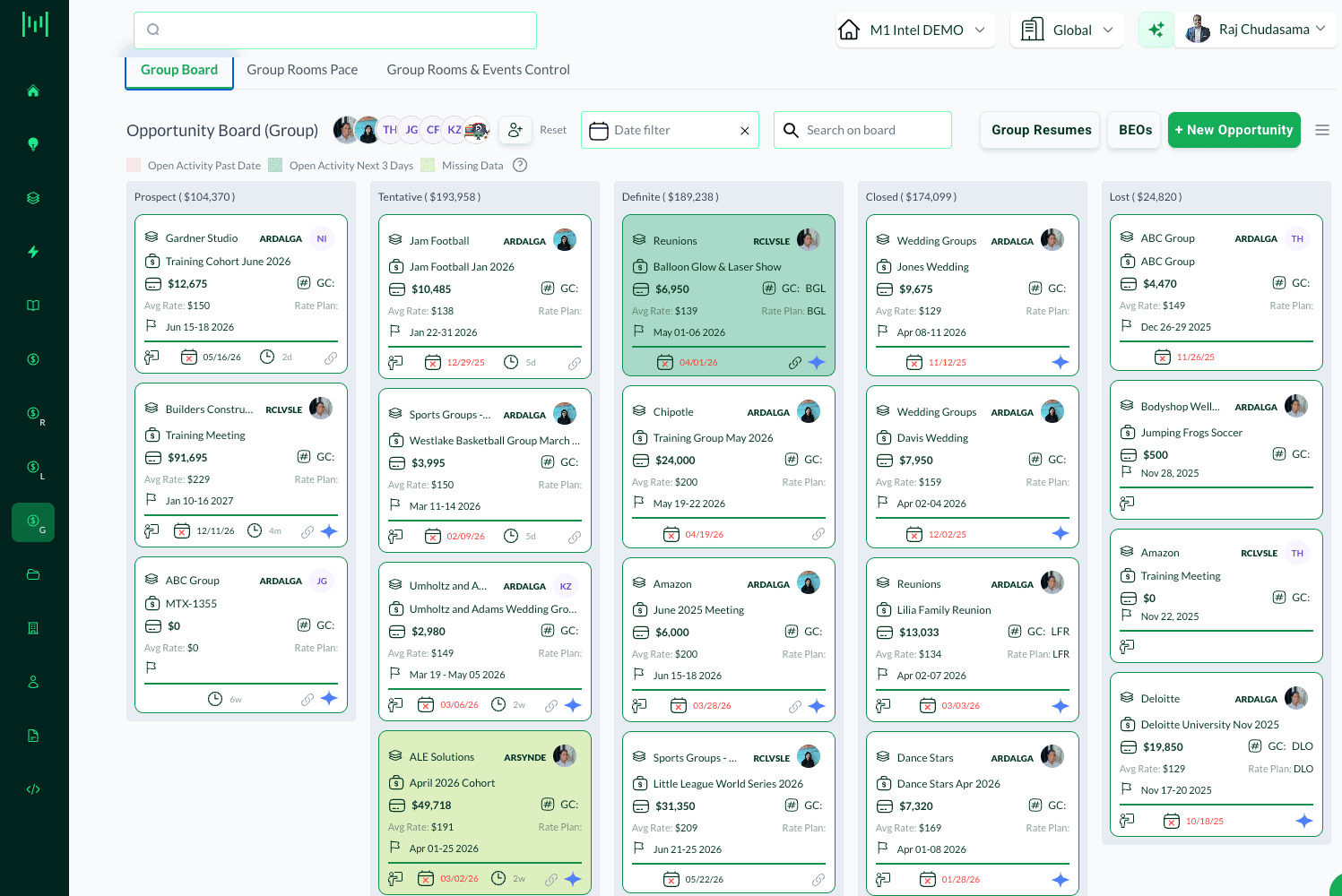
The workflow looks nothing like guest marketing. A planner sends an RFP for a 200-room program. A seller qualifies it, builds the opportunity, moves it through tentative to definite, and reports the booked production up the chain. No part of that touches a guest profile or a loyalty tier. This is the workflow our hotel B2B CRM overview covers in product detail.
Why the confusion hurts hotel sales teams
When a sales team goes looking for a CRM and lands on guest-CRM content, one of two things happens. Either they buy a guest CRM and discover months later that it has no real pipeline, no RFP workflow, and no account production reporting, so the team drifts back to spreadsheets. Or they bolt their sales process onto a generic CRM like Salesforce and spend the next year configuring and maintaining workflows a hotel sales tool would have shipped by default.
Both outcomes have the same root cause: the buyer compared tools across a category line they couldn't see. The cost shows up as a sales team running critical pipeline in a spreadsheet because the expensive CRM the property already owns doesn't fit how they sell. That gap is the subject of why most hotel sales CRMs fail sales teams.
What hotel sales teams actually need in a CRM
Strip away the category confusion and the requirements for a hotel sales team are specific and consistent.
Group sales pipeline tracking
The center of the tool. Group opportunities move through defined stages from inquiry to definite, with value, room nights, and arrival dates attached. The team needs to see the whole pipeline at a glance, sort by stage and value, and spot what's stalling. A guest CRM has no pipeline; a sales CRM is built around one.
RFP management and response workflows
Group and corporate business runs on RFPs that arrive from Cvent, MeetingBroker, brand channels, and direct email. The sales CRM has to capture them, track response time, manage the response, and report win rate by source. RFP response speed is one of the strongest predictors of who wins the business, which is why we track it as its own metric on the lead response time page.
Account production and B2B account management
Corporate accounts, LNR agreements, and repeat group clients are the book of business. The sales CRM tracks production by account over time, surfaces accounts that are trending down, and holds the relationship history a seller needs before a renewal conversation. This is account management in the B2B sense, not guest profile management.
Multi-property visibility for management companies
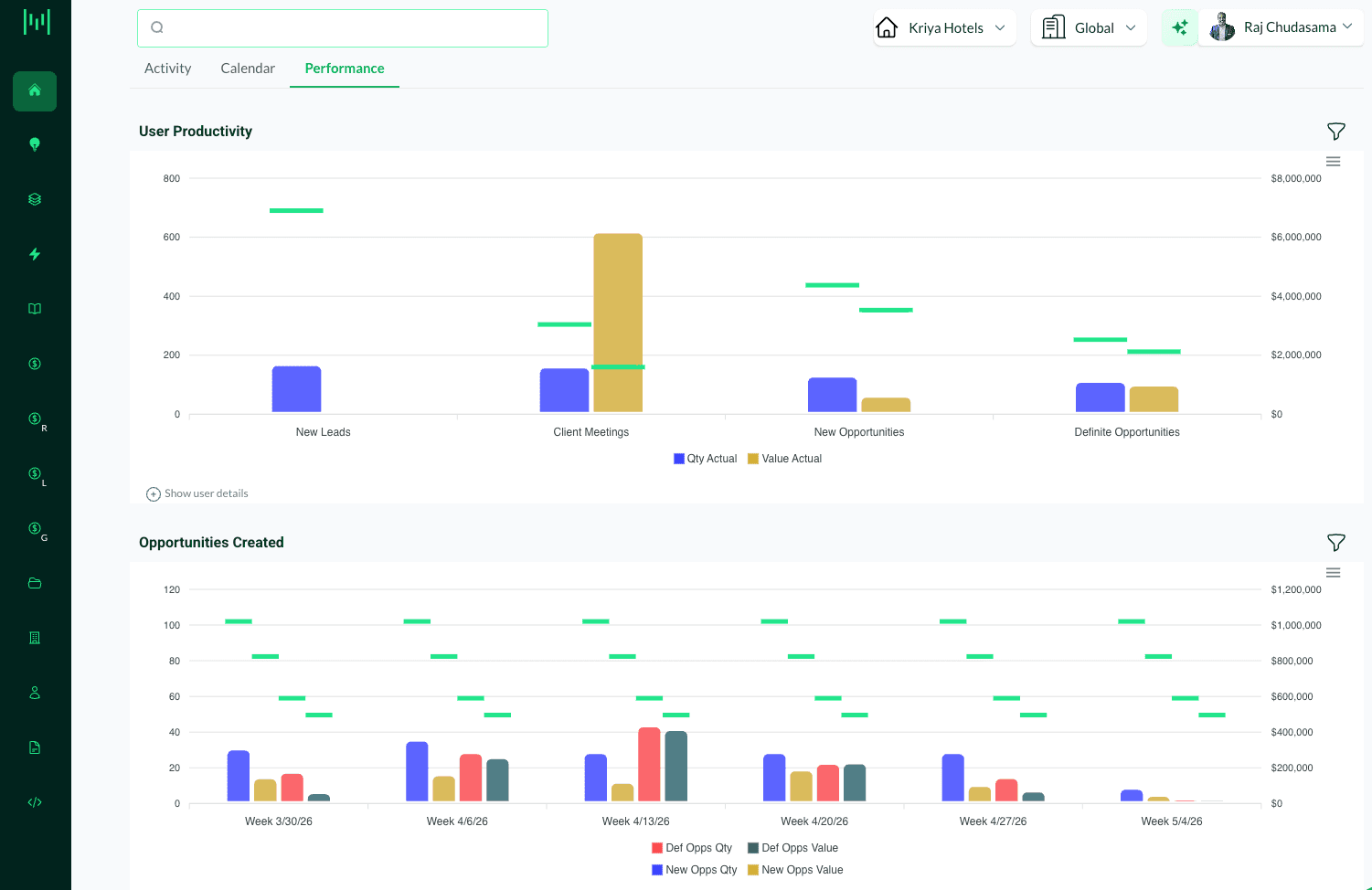
A management company runs sales across many properties at once. The tool has to roll every property's pipeline and production into one portfolio view, route leads across properties, and let above-property leadership see the whole operation. This is the requirement guest CRMs and single-property sales tools both miss, and it's covered in depth in our pillar on hotel sales software for management companies.
Ownership-ready reporting
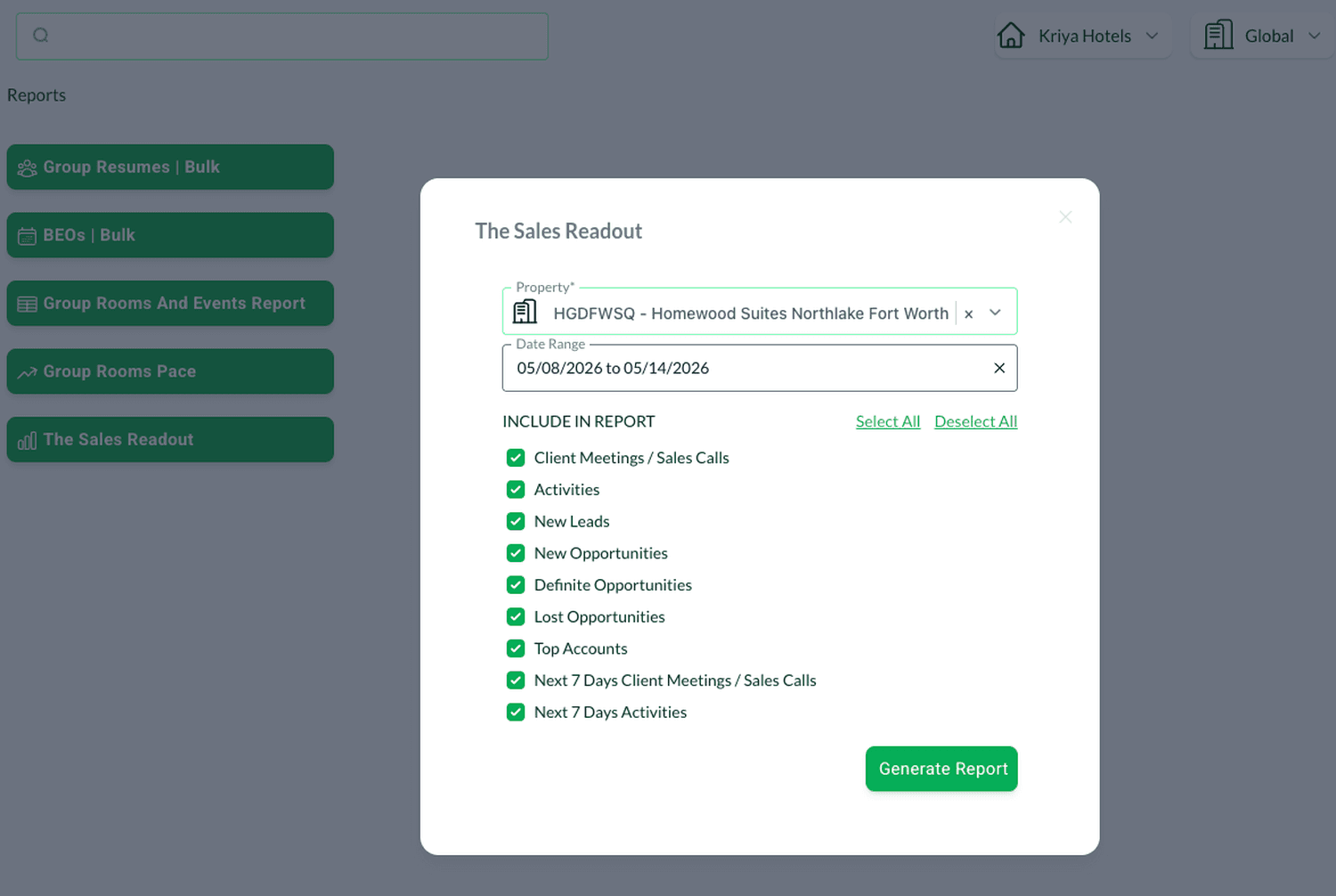
Sales leadership and ownership want a regular report: pace versus last year, pipeline value, RFP conversion, production by property. The sales CRM should generate it, not require someone to rebuild it in a spreadsheet every week.
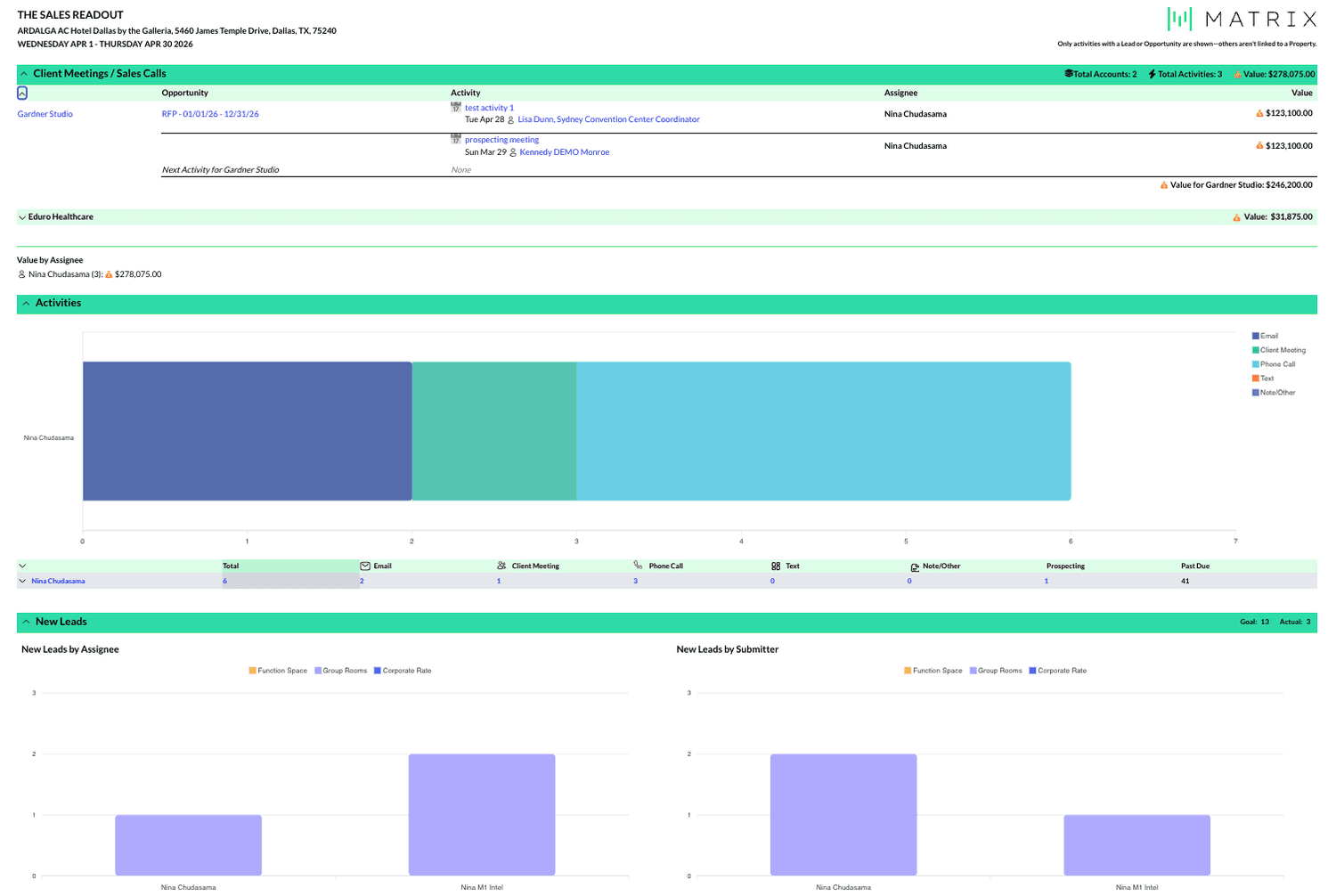
We cover the full reporting workflow in automated ownership reporting for hotel management companies.
The hotel CRM market split
Once you can see the category line, the market sorts into three groups. Knowing which one a tool belongs to is most of the buying decision.
Guest-first CRM tools
Cendyn, Revinate, and the CRM layers in PMS platforms. Built around the guest: profiles, loyalty, marketing automation, direct booking. The right tool for the marketing and revenue team. The wrong tool for a sales team that needs a pipeline.
Sales-first hotel CRM tools
Purpose-built hotel sales platforms. Built around the B2B sales workflow: group pipeline, RFP, account production, sales reporting. This includes legacy sales-and-catering tools like Delphi, single-property tools like Event Temple and STS Cloud, and portfolio-first platforms like Matrix. For the full side-by-side, see our comparison of hotel CRM software for group and B2B sales.
Generic CRMs adapted for hotels
HubSpot, Salesforce, Zoho. General-purpose CRMs configured for hotel sales. Flexible and powerful, but every hotel-specific workflow has to be built and maintained, and the hotel reporting isn't there by default. Workable when a company already runs the platform; expensive to adapt from scratch.
How to choose the right category
Start with the user and the job. If the job is guest marketing and loyalty, you want a guest CRM. If the job is running group and corporate sales (pipeline, RFPs, account production, reporting to ownership), you want a hotel sales CRM, and at portfolio scale you want a sales-first tool built for multiple properties. Comparing across categories is the mistake; pick the category first, then compare inside it. The broader tool landscape is mapped in the hotel sales software guide.
What to look for in a hotel sales CRM
Inside the sales-first category, the evaluation comes down to a short list.
Pipeline and stage management that matches how group sales actually moves, from inquiry through tentative to definite, with value and room nights on every opportunity. RFP and group workflow support that captures inquiries from every channel and tracks response time and win rate. Portfolio reporting that rolls every property into one ownership-ready view without manual assembly. Cross-property lead routing so a lead that fits multiple hotels gets to the right seller without dying in an inbox, the problem we cover in cross-property lead routing. Data ownership, so your account history and production records are yours to export, not locked in a vendor. And adoption speed, because a sales tool the team won't use is worse than the spreadsheet it replaced.
Where Matrix fits
Matrix is the sales intelligence layer for hotels, built for the sales-first category and for portfolio scale. It does the hotel sales CRM job (accounts, opportunities, group pipeline, RFP workflow, account production) and adds the intelligence and reporting layer that property-level CRMs and guest CRMs don't produce.
The difference from a guest CRM is the whole data model: Matrix is built around leads, opportunities, and corporate accounts, not guest profiles and loyalty tiers. The difference from a single-property sales tool is that accounts, pipeline, and reporting live at the portfolio level, so a management company runs every property in one workspace with cross-property routing and ownership reporting built in. The difference from a generic CRM is that the hotel sales workflows ship by default, so the team is operational in weeks without a Salesforce admin maintaining custom configuration.
Matrix comes from operators running portfolio sales, not from a vendor adapting a guest platform or a generic CRM. Pricing is per-property, not per-seat, so giving the whole sales org visibility doesn't change the bill. See the Matrix product page for the full picture, current pricing for plans, or book a demo below to see it on your own pipeline.
Frequently asked questions
Related resources
For deeper coverage of the topics in this guide:
- Hotel sales software for management companies: the pillar this page supports, on portfolio-level sales operations.
- Hotel B2B CRM for sales teams and management companies: the Matrix product view of a hotel sales CRM.
- Hotel CRM software comparison for group and B2B sales — the major hotel sales platforms side by side.
- Hotel group sales pipeline metrics — the metrics a sales CRM should track.
- Hotel sales software — the wider category map.
- What agentic AI changes for hotel sales teams — why the B2B side of the house has a different AI exposure than the guest side.
If you're deciding between a guest CRM and a hotel sales CRM for your team, the demo is twenty minutes on your own data, not a generic walkthrough.
What is the difference between a hotel CRM and a guest CRM? A guest CRM manages the relationship with individual travelers: profiles, booking history, loyalty, email marketing, and direct-booking campaigns. Its user is the marketing or revenue team. A hotel sales CRM manages B2B sales: group leads, RFPs, corporate accounts, the opportunity pipeline, and production reporting. Its user is the sales team — the DOSM, group sales manager, and above-property leadership. Both get called a hotel CRM, which is why buyers end up comparing tools that do completely different jobs.
Do hotel sales teams need a different CRM than the guest marketing team? Usually yes. The guest CRM the marketing team runs (Cendyn, Revinate, a loyalty platform) is built around the guest journey and has no real concept of a group opportunity, an RFP, or a corporate account pipeline. The sales team needs a tool built around their workflow: lead intake, group pipeline stages, account production, and reporting to ownership. The two tools serve different users and different data, and forcing one to do the other's job is where sales teams end up back in spreadsheets.
What CRM do hotel management companies use for group sales? Management companies need a CRM that works across a portfolio, not one property at a time. That rules out most guest CRMs and most single-property sales tools. The practical options are purpose-built hotel sales platforms with portfolio-level pipeline, cross-property account visibility, and ownership reporting. Matrix is built for exactly this: one workspace covering every property, with group sales, RFP, and account production rolled up for above-property leadership.
Is Cendyn a hotel sales CRM or a guest CRM? Cendyn is primarily a guest-focused platform: its CRM strengths are guest profiles, loyalty, and marketing automation for direct bookings. It's a strong tool for the marketing and revenue side. It is not built around the B2B hotel sales workflow — group pipeline, RFP response, corporate account production, multi-property sales reporting. A hotel sales team evaluating Cendyn as a sales CRM is evaluating it for a job it wasn't designed to do. See our full Matrix vs. Cendyn comparison for the detail.
What is a hotel sales intelligence layer? It's a category beyond CRM. A CRM records the sales activity; a sales intelligence layer also surfaces what the activity means — group pace versus last year, pipeline velocity, lead response time, account production trends — and routes work across a portfolio. Matrix is built as the sales intelligence layer for hotels: it does the CRM job (accounts, opportunities, pipeline) and adds the portfolio reporting and intelligence that property-level CRMs and guest CRMs don't produce.
Can I use HubSpot or Salesforce as a hotel sales CRM? You can configure them to, and some hotels do. The cost is that you're building hotel sales workflows (group blocks, RFP stages, account production, group pace) on top of a generic CRM, which means custom configuration, an admin to maintain it, and no hotel-specific reporting out of the box. A purpose-built hotel sales CRM ships those workflows by default. The generic-CRM route makes sense mainly when a hotel group already runs Salesforce company-wide and wants one platform.