

In hotel revenue management, most leading indicators arrive too late to be truly useful. Pickup data reflects what’s already happening. Competitive rate intelligence tells you what the market is doing now. Historical patterns tell you what last year looked like. But by the time those signals move, the window to influence the outcome has often already closed.
Group pace is different. It is one of the few metrics in hotel revenue strategy that gives you a meaningful read on future demand weeks or months before it crystallizes into bookings — far enough in advance to change your pricing posture, focus your sales team on specific dates, or flag a problem to ownership before it shows up in a variance report.
The catch: group pace is only as useful as the pipeline data behind it. And that pipeline data lives entirely in the sales team’s hands.
What Is Hotel Group Pace?
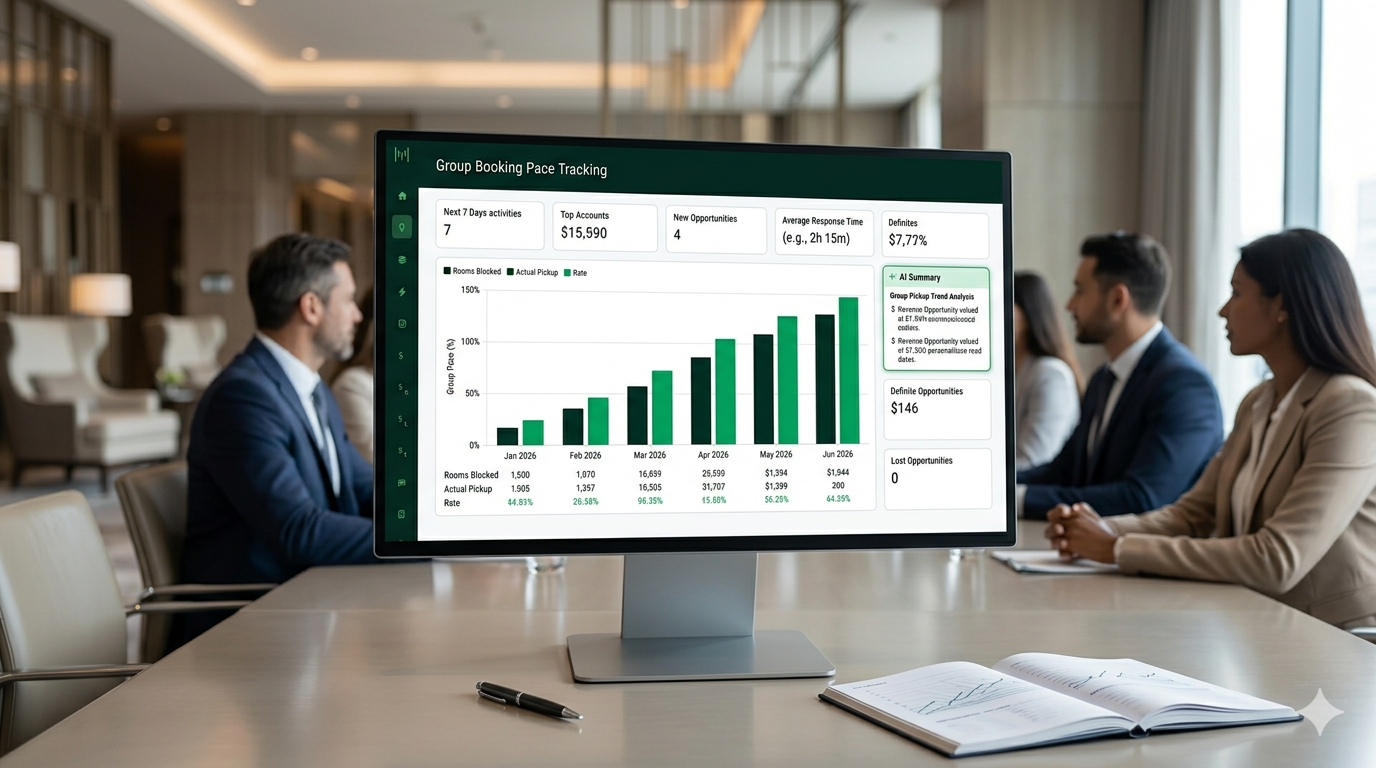
Hotel group pace measures how group room revenue currently on the books for a future date range compares to the same point in a prior period — typically the same week last year, or against a defined pace target built into the annual budget.
A property running ahead of pace on group for a set of October dates means it has more group revenue confirmed at this point than it did at the same point last year for those same dates. Behind pace means the opposite — group is building more slowly than historical norms, which signals a potential shortfall.
Pace is usually expressed as a percentage above or below prior year: +12% pace means group is tracking 12 points ahead. -8% means the property is behind and needs either sales acceleration or a revised transient strategy to compensate.
Unlike occupancy or ADR — which measure what’s already happened — group pace is prospective. It tells you the trajectory of future performance while you still have time to act.
Why Group Pace Is the Earliest Leading Indicator Available
Revenue managers work with several types of forward-looking data. Transient booking pace tells them how room reservations are accumulating for future dates. Market demand tools show how competitors are pricing. Group pace adds a third dimension that neither of those can provide: visibility into demand that is in negotiation or contract, not just on the books.
A group booking confirmed today for next September was in a pipeline for weeks or months before it closed. Revenue managers who only see confirmed group miss the entire lead time of that deal. Revenue managers who can also see pipeline-stage group — what’s in proposal, what’s under contract review, what’s at 70% close probability — have a fundamentally different picture of where demand is heading.
That pipeline-informed view of group pace is what separates hotels that react to revenue problems from those that prevent them. The sales team controls every data point that makes it possible.
How Revenue Managers Use Group Pace to Make Pricing Decisions
Group pace directly influences transient pricing strategy in several ways.
Holding rate on high-pace dates
When group pace is strong for a date range, revenue managers have a firmer demand base to price against. They can hold transient rates at higher levels with more confidence, knowing group is already building the occupancy foundation. Discounting transient to drive volume on dates where group pace is ahead is often unnecessary — and erodes rate that didn’t need to move.
Protecting transient inventory on low-pace dates
When group pace is behind for specific dates, revenue managers face a choice: compensate with transient pricing to drive pickup, focus sales effort on those specific dates, or both. Either way, seeing the gap early — weeks or months out — creates options. Seeing it two weeks before arrival creates stress.
Displacement analysis
When a group inquiry comes in for dates where transient pace is already strong, the displacement decision — should we take this group and at what rate — depends partly on how confident the revenue manager is in the transient demand. Group pace data for those dates is a direct input into that calculation. Strong transient pace + a below-market group rate = a deal that may cost more than it contributes.
Forecasting accuracy
Revenue managers produce weekly and monthly forecasts that ownership and asset managers review. Group pace — particularly when it incorporates pipeline-stage business with probability weighting — dramatically improves the accuracy of those forecasts. A revenue manager who knows that three groups at 75% probability are in negotiation for a set of dates can build a meaningfully different forecast than one who is working only from confirmed reservations.
Pace without pipeline is just history
Group pace built only from confirmed bookings tells you where you’ve been. Group pace that incorporates pipeline-stage opportunities — with probability weighting by stage — tells you where you’re going. The difference is entirely about how well the sales team captures and maintains their deal data.
Why Group Pace Requires Clean Sales Pipeline Data
The quality of group pace reporting depends entirely on the quality of the data feeding it. Specifically:
- Date accuracy: Pace is date-specific. A group logged without confirmed arrival and departure dates can’t be mapped to a pace report for specific periods.
- Room block size: Without a contracted or estimated room block, the group’s contribution to pace is unknown. Vague entries like “approx 50 rooms” produce imprecise pace data.
- Pipeline stage: A group at 80% probability should be weighted differently in a pace model than one at 20%. Stages must be consistently defined and consistently updated by the sales team.
- Regular updates: A deal logged three months ago and never touched doesn’t reflect current reality. Stale pipeline data produces stale pace reports, which produce bad forecasts.
This is why the connection between sales discipline and revenue management accuracy is direct. A sales team that logs deals consistently and keeps pipeline stages current gives the revenue manager the inputs needed to produce reliable pace reports. A sales team that manages deals informally produces the kind of pipeline data that’s worse than no data — because it creates false confidence in a report that doesn’t reflect reality.
For a deeper look at how hotel group sales pipelines should be structured to support this kind of reporting, see our guide to hotel group sales pipeline metrics.
Group Pace Reporting for Management Companies
For single-property hotels, group pace is a challenge of discipline and tooling. For management companies operating across multiple properties, it adds a consolidation layer: how do you see group pace across every property in the portfolio in a single view, without waiting for each revenue manager to submit a weekly report?
Portfolio-level group pace reporting requires standardization that most single-property tools weren’t built to provide. Pace targets need to be defined consistently. Pipeline stages need to mean the same thing at every property. Date-range definitions for pace comparisons need to be uniform. Without that common layer, rolling up group pace from five properties produces a number that’s not comparable across the portfolio.
Management companies that get this right build their group pace reporting on top of a shared sales pipeline infrastructure — one that captures deal data consistently at the property level and rolls it up automatically for ownership and asset management review. For a look at the KPIs that support this model, see our guide to hotel sales KPIs for management companies.
Connecting Group Pace to the Broader Revenue Strategy
Group pace doesn’t exist in isolation. It’s one input into a coordinated revenue strategy that requires both the sales team and revenue management to be working from the same data and toward the same goals.
When group pace is reviewed jointly — in a weekly revenue strategy meeting where both the sales director and revenue manager are present — it becomes an action trigger rather than a reporting artifact. Behind on pace for March? The sales team knows which dates to prioritize in outbound prospecting. Ahead of pace for February? The revenue manager knows those dates can hold transient rates.
That coordination is the practical output of connecting group sales and revenue management as a shared system. For a full look at how those two functions work together, see our guide to how group sales drives hotel revenue management.
Track Group Pace Across Every Property — In Real Time
Matrix gives revenue managers and sales directors a shared view of group pace, pipeline stage, and booking velocity — by property and across the portfolio — without manual exports or weekly report requests.
Frequently Asked Questions
What is hotel group pace?
Hotel group pace measures how group room revenue currently on the books for a future date range compares to the same point in a prior period — typically the same week last year or against a budget target. It is a leading indicator of future group demand, used by revenue managers and sales directors to guide pricing strategy and sales prioritization.
Why does group pace matter for revenue management?
Group pace gives revenue managers forward visibility into demand that transient booking data and market rate tools cannot provide. When group pace is strong for specific dates, revenue managers can hold transient rates with more confidence. When pace is behind, they can flag the gap early enough to respond — either through targeted sales outreach on those dates or through adjusted transient strategy.
How is group pace calculated?
Group pace is typically calculated by comparing current group room revenue on the books for a future date range to the same metric at the same point in a prior year, expressed as a percentage above or below prior year. More sophisticated models incorporate pipeline-stage business with probability weighting, so the pace report reflects not just confirmed bookings but the realistic expected value of deals in negotiation.
What data does the sales team need to provide for accurate group pace?
For group pace reports to be reliable, the sales team needs to log group opportunities with confirmed or estimated arrival and departure dates, contracted or estimated room block size, current pipeline stage, and close probability. Deals must be kept current — stale pipeline entries produce misleading pace data that can result in bad pricing decisions.
How do management companies track group pace across multiple properties?
Management companies track portfolio-level group pace by standardizing pipeline stage definitions and pace target methodology across all properties, then using a shared sales platform to aggregate data centrally. This allows ownership groups and regional leadership to see group pace by property and across the portfolio without waiting for manual weekly submissions from individual revenue managers.