
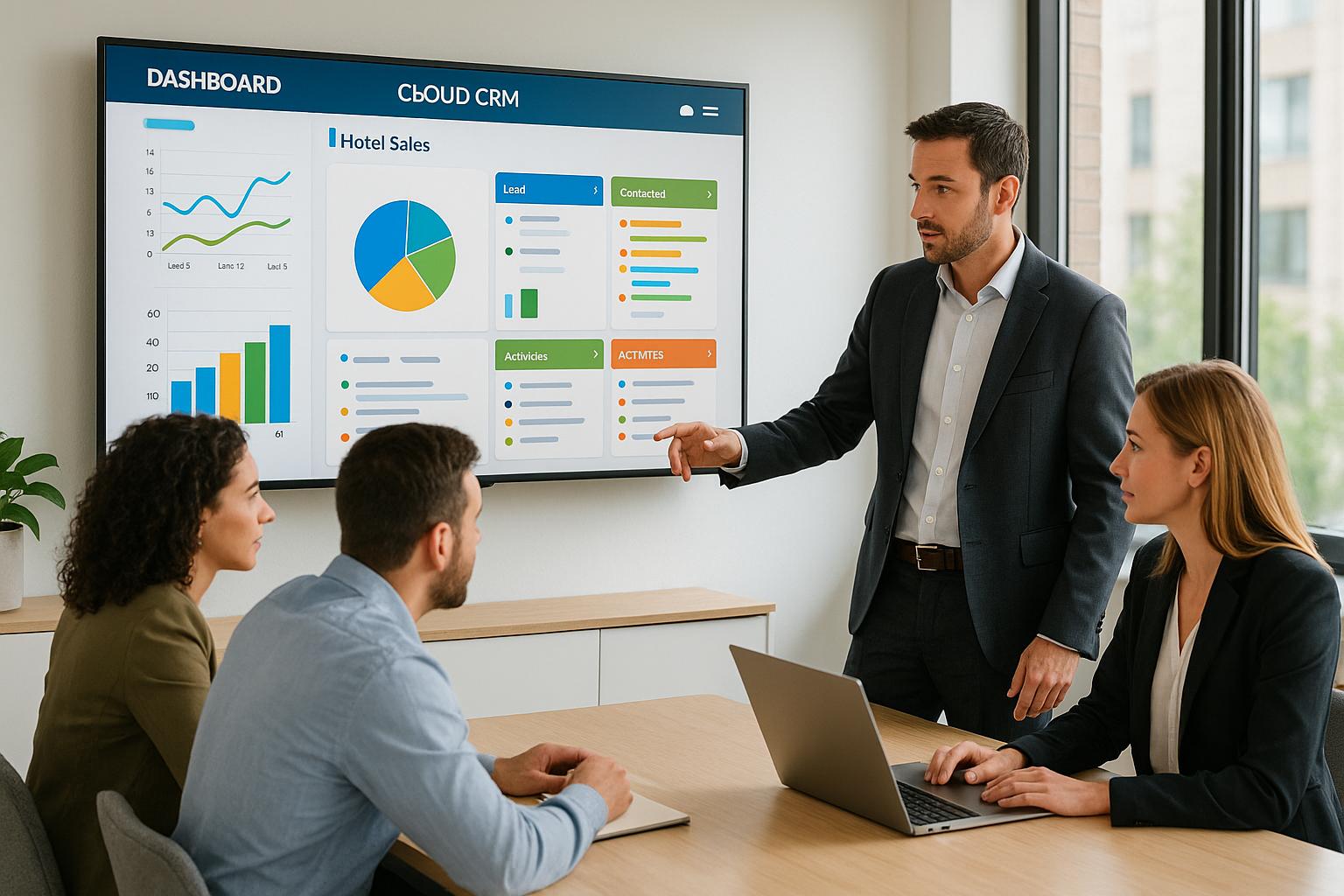

AI-powered cloud CRM systems are transforming hotel sales by automating tasks, improving lead management, and providing personalized guest experiences. Hotels using these systems report increases in revenue (up to 17%) and occupancy (10%), thanks to features like AI-driven lead scoring, automated follow-ups, and real-time analytics. With the global AI in hospitality market projected to grow from $1.4 billion in 2020 to $4.4 billion by 2025, adopting this technology is becoming essential for staying competitive.
Key Takeaways:
- Revenue Growth: AI tools boost hotel revenue by 10–15% on average.
- Efficiency: Automates daily tasks, saving time and reducing errors.
- Personalization: Customizes guest interactions to improve satisfaction.
- Unified Data: Centralized platforms streamline operations across properties.
- Future Trends: AI content creation, predictive analytics, and chat support will further refine sales strategies.
Hotels that adopt AI-powered cloud CRM systems now position themselves to meet growing guest expectations and improve operational efficiency across the board.
Sage Hospitality‘s CTO on Infusing AI Into the Hotel Tech Stack

Common Hotel Sales Problems
Hotel sales teams encounter numerous challenges that can drain efficiency and impact performance. Let’s explore some of the most pressing issues they face and why smarter tools, like AI-powered cloud CRM systems, are becoming essential.
Lead Management and Prioritization Problems
Hotels deal with a flood of inquiries every day, making it tough to pinpoint which leads are worth pursuing. Without a proper lead scoring system, sales teams often waste time chasing prospects who are unlikely to book. The lack of accurate or complete guest personas doesn’t help either – it makes it harder to identify leads who are genuinely interested, have immediate needs, or hold the authority to make decisions. This inefficiency can snowball into other problems, like delayed follow-ups.
Poor Timing and Lack of Personalization in Follow-Ups
In sales, timing can make or break a deal, and this is especially true in the hospitality industry. Missed or poorly timed follow-ups often lead to lost opportunities. Guests today expect service that’s not only prompt but also tailored to their needs. According to the Zendesk Customer Experience Trends Report 2024, most customers now demand interactions that feel personal, genuine, and well-informed.
"Customers expect a personalized experience via all channels. We should know our customer and personalize their experience, regardless of what channel they engage with us in." – Heather Wintermantel, senior director of customer experience strategy and programs at Zendesk
Adding to the pressure, the AI-Powered CX Report reveals that 83% of customer experience leaders anticipate a fivefold increase in service interactions over the next three years. For hotels, failing to deliver timely and personalized responses could mean falling behind in a highly competitive market.
Fragmented Data Across Multiple Properties
Data disconnection is another major hurdle for hotel sales teams. On average, sales professionals spend only 30% of their time selling, with the rest eaten up by administrative tasks and data entry. This issue becomes even more pronounced in multi-property hotel groups, where systems often fail to communicate effectively. For example, when Stonebridge Companies expanded its portfolio to over 160 hotels in 2024 through its acquisition of Real Hospitality, they faced significant challenges in consolidating data across properties.
"It’s fantastic to have data from all properties cohesively organized in a single platform. No matter which brand or hotel we’re looking at, the information is ready in our standard format." – Donna Paraliticci, Regional Director of Sales and Revenue Management at Mid-Continent Hospitality
Without a unified system, gathering and analyzing data becomes a time-consuming task, slowing down decision-making and creating operational inefficiencies.
Manual Processes That Hinder Sales Efficiency
The absence of automation is another bottleneck for hotel sales teams. Disconnected systems often require staff to manually transfer data, which not only wastes time but also increases the likelihood of errors. Inconsistent reporting and scattered guest data make it nearly impossible for central teams to benchmark performance or derive actionable insights. Without streamlined operations, the risk of inaccuracies rises, further complicating the sales process .
How AI-Powered Cloud CRM Solves Hotel Sales Problems
Hotels often grapple with challenges like inefficient lead management and scattered data. AI-powered cloud CRM systems address these pain points by offering precise, automated solutions that improve lead management, guest communication, and operational workflows across multiple properties.
AI Lead Scoring and Ranking
AI lead scoring uses machine learning to evaluate and rank prospects based on historical data, behavior, and engagement patterns. This data-driven method minimizes human error and creates a unified scoring system that aligns sales and marketing efforts.
In fact, a survey revealed that 98% of sales teams believe AI helps improve lead prioritization.
Automated Personal Follow-Up Messages
AI takes follow-up communications to the next level by analyzing guest data to deliver personalized, perfectly timed messages. By customizing tone, timing, and content for each guest, these systems significantly enhance engagement.
"AI can tailor the tone, timing, and content of communications to match each guest’s preferences, enhancing engagement."
– Are Morch, Digital Transformation Coach for Hotels
With 71% of consumers expecting personalized interactions, automated follow-ups triggered by guest behavior or booking milestones ensure no opportunity slips through the cracks.
Centralized Data with Smart Search
AI-driven smart search tools provide instant access to accounts, contacts, and opportunities across a hotel’s portfolio. This turns raw data into actionable insights.
For example, The Lodge at Flying Horse utilizes these tools to identify event planners more effectively. By applying filters like organization type, location, and industry, they connect with the right prospects more efficiently.
"Planner Navigator has brought me closer to clients, and it’s taken so much of the work out of trying to find the right planner. It allows me to hone in on the best planners and those producing in our market. It’s just such an easy tool for me to identify the appropriate contacts, and then to open the door on my own and build that relationship in a more personal manner."
– Jeff Howell, Director of Sales and Marketing, The Lodge at Flying Horse
This feature is particularly crucial when 80% of planners expect responses to their RFPs within four days. Beyond just providing instant access to data, AI transforms these insights into practical strategies.
AI Analytics for Smarter Business Decisions
AI analytics turn raw data into meaningful insights, making proposals and presentations more impactful. This capability helps sales teams communicate their key points more effectively, ensuring they stand out in a competitive market.
Automated Daily Tasks
AI automation streamlines routine tasks, such as customizing proposals to meet specific market demands. These tools build on earlier improvements in follow-ups and data centralization, creating a seamless workflow.
Matrix, M1 Intel‘s hotel sales automation platform, is an excellent example of this in action. With its intuitive interface and built-in Algolia Search feature, users can quickly locate accounts, contacts, and opportunities. This boosts both speed and accuracy throughout the sales process, while also maintaining full data ownership and enabling collaboration in multi-user environments.
What to Consider When Choosing AI-Powered Cloud CRM
When selecting an AI-powered cloud CRM for your hotel, it’s important to focus on integration, ease of use, security, and adaptability. These factors ensure the CRM not only addresses sales challenges but also boosts overall efficiency. Overlooking these elements can lead to operational hiccups and costly setbacks.
System Integration Requirements
A CRM that integrates smoothly with your existing hotel tools is non-negotiable. It should work seamlessly with your property management system (PMS), point-of-sale (POS) systems, and booking platforms. Additionally, it should support communication across email, SMS, online messaging, and social media to provide a unified ecosystem for guest data and interactions. Some modern hotel CRMs can connect with over 85 hotel-related systems, but not all integrations are equally reliable.
Good integration eliminates the need for manual data entry. It allows your team to track room availability, guest preferences, and purchase history – all from one central hub. When considering a CRM, ask vendors about specific integrations and request live demonstrations to see how data flows between systems. Opt for a provider that offers not just dependable integrations but also thorough training and support to ensure a smooth onboarding process. And remember, a user-friendly interface is just as crucial for quick adoption by your team.
Easy-to-Use Team Interfaces
Even the best-integrated system won’t succeed if your team finds it hard to use. A user-friendly interface is essential for staff adoption and maximizing the CRM’s potential. Intuitive designs help teams leverage AI features effectively. For instance, Marriott International uses AI systems with simple interfaces to tailor guest offers based on past stays, boosting loyalty and direct bookings. Hilton has also seen success with smart room technology and chatbots, which have reduced response times and improved guest satisfaction.
To ensure the CRM meets the needs of all departments, involve key stakeholders early in the selection process. Look for systems with collaborative features that encourage teamwork across your hotel portfolio.
Data Security and Ownership Rights
Protecting guest and business data is non-negotiable. The hospitality industry’s cybersecurity risk score jumped to 10.0 in early 2024, up from 7.4 in 2023, with the average cost of a data breach now at $3.4 million. High-profile incidents, like MGM Resorts’ $100 million loss and Caesars Entertainment’s $15 million ransom payment, highlight the stakes.
When evaluating CRM vendors, prioritize those offering strong security measures like end-to-end encryption, multi-factor authentication, and compliance with standards such as PCI DSS and GDPR. Trust is a key factor – 96% of respondents in a recent survey ranked it as critical when choosing AI vendors. Ensure the CRM provides clear policies on data ownership, collection, and usage. Transparency with guests about how their data is used, along with easy opt-out options for AI-driven interactions, is also vital.
Flexible Tools for Different Hotel Types
Your CRM should adapt to your brand’s needs and grow with your business. Whether you operate a boutique hotel or a large chain, your CRM should address your unique challenges and guest expectations. Smaller properties, for example, may need systems that are affordable and easy to train staff on, while larger operations might require scalable solutions that support multiple brands under one portfolio.
Customization is key. Tailor the CRM to align with your brand’s workflows and service standards. For multi-property operators, look for systems that provide centralized management while allowing individual locations to maintain their unique identities and guest relationships. With 92% of respondents emphasizing the importance of a strong data strategy for AI success, choose a CRM that not only meets today’s needs but also evolves with emerging technology and shifting guest demands.
sbb-itb-a5d89e3
Future AI Trends in Hotel Cloud CRM
The global AI in hospitality market is expected to surge from $150 million in 2024 to $240 million in 2025, reflecting a compound annual growth rate (CAGR) of 57%. This rapid expansion is set to reshape how hotels manage guest relationships and sales strategies. With AI already proving its worth in lead management and automation, the next wave of advancements promises to elevate hotel sales and guest engagement even further. These developments point to exciting possibilities in content creation, predictive analytics, customer support, and real-time insights.
AI Content Creation Tools
AI-driven content creation is changing the way hotels communicate with guests and prospects. These tools can automatically generate personalized sales emails, proposals, and marketing materials that align with a hotel’s unique brand identity. This automation allows sales teams to focus more on building meaningful connections while leaving the content creation to AI.
For example, The Hotels Network‘s AI Assistant empowers hoteliers to craft personalized, multilingual website messages that enhance direct booking strategies and improve user experiences. Beyond websites, AI-generated emails, chatbot conversations, and concierge messages ensure consistency throughout the guest journey. AI also optimizes digital advertising by pinpointing the most effective channels, audiences, and timing for campaigns. Considering that 80% of consumers are more likely to make a purchase when brands offer personalized experiences, these tools are becoming indispensable for staying competitive.
But AI’s impact doesn’t stop at content – it’s also transforming how hotels predict and plan for the future.
Better Prediction Accuracy
AI’s ability to learn from data continuously allows for increasingly accurate forecasts. Hotels using AI report impressive results, including a 17% rise in revenue and a 10% increase in occupancy compared to those relying on traditional methods.
"AI’s impact on hotels revenue management goes beyond simple automation. It’s about leveraging complex algorithms and machine learning capabilities to analyze vast amounts of data from multiple sources, identify patterns, and make predictions with a level of accuracy and speed that surpasses human capabilities." – Jean-Marc Robillard, Head of Marketing @ Pricepoint
AI-powered forecasting systems analyze historical booking trends, market dynamics, and external factors such as weather or local events to provide precise demand predictions. By identifying subtle patterns that human analysts might overlook, these systems help hotels optimize inventory, reduce overbooking or underbooking, and adjust pricing in real time. Unlike traditional forecasting methods, which often falter during sudden market shifts, AI adapts swiftly to changing conditions, enabling hotels to make proactive decisions about staffing, inventory, and pricing.
These predictive insights work hand-in-hand with AI-driven guest support systems.
AI Assistants and Chat Support
AI assistants and chatbots are evolving into powerful tools for customer service and sales. These systems handle guest inquiries, bookings, and tailored recommendations 24/7. With 70% of guests finding chatbots helpful for simple tasks, their acceptance is growing quickly.
In March 2023, Marriott International leveraged AI-powered chatbots to engage with guests before, during, and after their stays. Guests could request services, book amenities, and receive personalized suggestions, all while hotel staff focused on more complex responsibilities. Additionally, real-time translation features are breaking down language barriers, making it easier to cater to international travelers and enhancing service quality across borders.
These advancements complement AI’s ability to analyze and act on live data.
Live Data Analysis and Customer Grouping
Real-time data processing is revolutionizing how hotels understand and segment their guests. By analyzing both historical and current data, AI can predict guest preferences, behavior patterns, and demand, enabling highly targeted marketing campaigns tailored to individual profiles and demographics. With 63% of consumers expecting personalized experiences based on prior interactions, these capabilities are vital for meeting modern guest expectations.
AI also identifies revenue opportunities by analyzing patterns and anomalies in data. This allows hotels to uncover upselling and cross-selling opportunities and trigger personalized offers at the perfect moment during a guest’s journey.
As AI adoption in the hospitality industry grows at an estimated rate of 60% annually from 2023 to 2033, hotels that embrace these technologies will position themselves to strengthen guest relationships and unlock new revenue streams.
Conclusion: The Future of Hotel Sales Technology
AI-powered cloud CRM systems are reshaping the way hotels approach sales, turning traditional, reactive methods into proactive strategies that drive revenue growth. Hotels leveraging AI-based revenue management tools have reported impressive gains, including a 10% increase in revenue per available room and an overall revenue growth of 20–30%.
These tools go beyond simple automation. Features like AI-driven lead scoring have been shown to improve conversion rates by 28%, shorten sales cycles by 26%, and boost productivity by as much as 30%. By replacing manual guesswork with precise, data-driven insights, these systems consistently deliver tangible results.
Major hotel brands are already seeing the benefits. For example, Marriott International and InterContinental Hotels Group have each reported notable improvements in their revenue per available room (RevPAR), with increases of up to 15% and 5%, respectively, after adopting AI-driven solutions.
Guest expectations are evolving too. With 62% of guests open to AI-enhanced personalization, hotels have an opportunity to strengthen guest relationships through targeted marketing strategies, which can lead to revenue lifts of up to 25%.
The pace of AI adoption in the hospitality industry is accelerating, with projections indicating a 60% annual growth rate from 2023 to 2033. For hotels aiming to stay ahead, embracing AI-powered CRM systems now is essential. These tools not only help capture market share but also enhance guest satisfaction and provide a clear competitive advantage.
To make the most of this technology, hospitality professionals should prioritize systems that offer smooth integration, user-friendly interfaces, strong data security, and tools tailored to their specific needs. The future of hotel sales has arrived – and it’s driven by the power of AI.
FAQs
How do AI-powered cloud CRM systems help hotels manage leads and improve guest communication?
How AI-Powered Cloud CRM Systems Are Changing Hotel Operations
AI-powered cloud CRM systems are reshaping the way hotels handle leads and interact with guests by automating essential tasks and providing smarter, data-driven insights. These systems leverage AI-driven analytics to rank leads based on their potential to convert, helping sales teams focus their efforts on the most promising opportunities.
Guest communication also gets a major upgrade. With automated, personalized outreach – via email, chat, and other platforms – hotels can reduce manual work, respond faster, and offer a more customized experience. This means less time spent on repetitive tasks and more time creating meaningful guest interactions. The result? Greater efficiency, happier guests, and increased revenue and loyalty for the hotel.
What should hotels consider when choosing an AI-powered cloud CRM to ensure it integrates smoothly and is easy for staff to adopt?
When choosing an AI-powered cloud CRM for your hotel, it’s crucial to ensure it integrates smoothly with your current systems and workflows. This helps prevent any interruptions in your operations and keeps things running efficiently.
A simple, intuitive interface is another must-have. It allows your staff to pick up the system quickly, cutting down on training time and minimizing any potential downtime.
Equally important is data security and privacy, especially since hotels manage a significant amount of sensitive guest information. Features like advanced analytics and predictive tools can make a big difference too. They help improve decision-making, offer more personalized guest experiences, and ultimately boost satisfaction for both your guests and your team. These elements work together to streamline operations and elevate the overall experience.
What AI trends should hotels focus on to enhance sales and guest experiences?
Hotels need to keep an eye on the latest AI trends, as they have the potential to reshape both sales strategies and guest interactions. Over the coming years, AI-powered automation is set to take over a significant portion of inbound guest communications, such as handling calls and answering inquiries. This shift promises faster responses and smoother operations.
Beyond automation, AI is opening the door to personalized guest experiences. Through tools like real-time engagement, predictive analytics, and smart concierge services, hotels can anticipate what guests want, offer custom recommendations, and deliver effortless interactions. These advancements not only help hotels differentiate themselves in a crowded market but also improve how they run their day-to-day operations.