
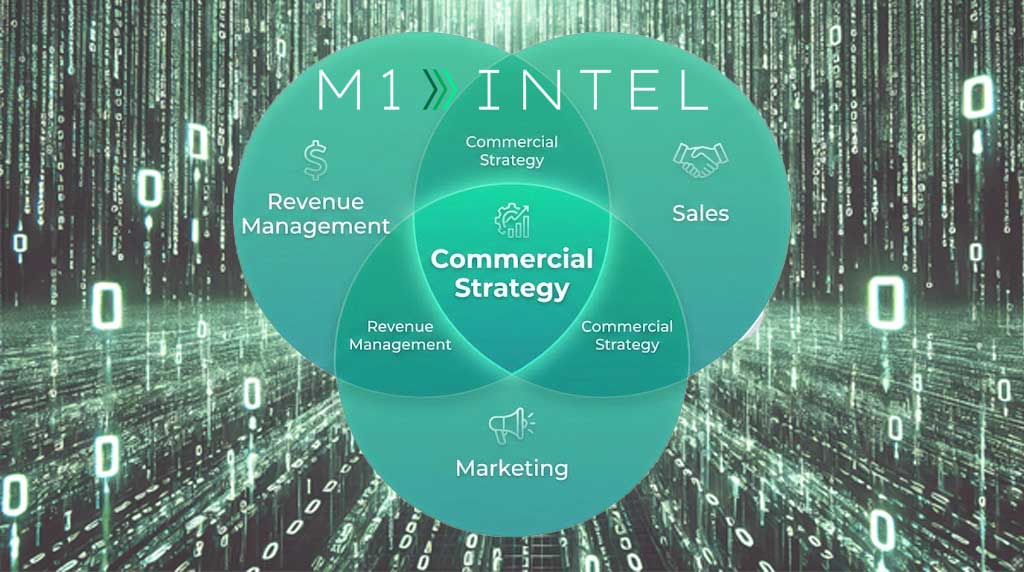

The hospitality industry has undergone a fundamental transformation. Gone are the days when revenue management, sales, and marketing operated as separate departments with distinct goals. In 2026, hotel management companies are discovering that sustainable profitability demands something different: commercial strategy.
Commercial strategy represents the integration of revenue management, sales, and marketing teams under a unified approach to maximize total revenue, capture demand, and enhance guest satisfaction. This shift from siloed operations to cross-functional collaboration is reshaping how hotels compete and win in an increasingly complex market.
For hotel management companies overseeing multiple properties across brands and markets, commercial strategy has moved from trendy buzzword to operational necessity. The question is no longer whether to adopt commercial strategy, but how to implement it effectively across portfolios.
The Evolution of Hotel Commercial Strategy
Commercial strategy emerged from the hospitality industry’s collective realization that traditional organizational structures were leaving revenue on the table. Before the pandemic, revenue managers optimized pricing in isolation, sales teams pursued group business independently, and marketing departments focused on brand awareness without tight revenue accountability.
COVID-19 disrupted these silos by necessity. Lori Kiel, Chief Commercial Officer at Kessler Collection, observed that when the pandemic forced industry professionals to wear multiple hats across commercial disciplines, organizations started seeing increased revenue. This collaboration revealed what had been hiding in plain sight: alignment produces results.
According to research from Hospitality Sales and Marketing Association International (HSMAI), 39% of North American hotel organizations have made progress in some areas of commercial strategy and plan to address others. The top drivers include emergence of new sales channels and models (18%), changes in customer needs and expectations, and the necessity of data-driven decision making.
Businesses with strong commercial strategy achieve revenue growth 1.9 percentage points higher and earnings growth about 4.7 percentage points higher than industry competitors, according to data from Revinate. These aren’t marginal improvements. They represent the difference between merely surviving and actively shaping market outcomes.
Core Components of Commercial Strategy
1. Revenue Management Integration
Modern revenue management extends far beyond setting room rates. In 2026, revenue management systems leverage AI-driven forecasting to analyze hundreds of demand signals simultaneously: look-to-book ratios, flight demand, metasearch trends, weather patterns, social event density, website analytics, and real-time market compression.
Hotels using advanced demand intelligence layers have seen occupancy improvements of approximately 10% in certain markets by capturing demand the moment it appears rather than reacting after opportunity has passed. STR Global research demonstrates ADR uplifts of 10-15% when moving from rules-based pricing to AI-driven forecasting and optimization.
Revenue managers are evolving from tactical rate-setters to strategic commercial leaders. Their role now encompasses total profit optimization across all revenue streams, requiring understanding of pricing, acquisition costs, operational efficiency, and gross operating profit. Revenue decisions inform marketing strategies, sales contributes pipeline insights, and distribution manages cost of sale. This interconnected approach prevents the domino effect where rising OTA commissions erode net operating income.
Total Revenue Per Available Guest (TrevPAG) has replaced Revenue Per Available Room (RevPAR) as the metric that matters. Properties are optimizing for profitability at every guest touchpoint, from pre-arrival offers to in-stay upgrades and final add-ons before departure. Gift voucher sales, spa bookings, and food and beverage revenue all feed into total revenue calculations.
2. Sales Team Alignment
Sales teams in commercially aligned organizations work with unprecedented visibility into pricing strategy and demand forecasts. This enables them to make informed decisions about group displacement, corporate rate negotiations, and which opportunities warrant pursuit.
Group displacement analysis exemplifies the power of AI-enabled commercial systems. What previously required hours of spreadsheet modeling now happens instantly, determining the profitability of group requests by weighing room revenue, ancillary potential, displacement cost, wash likelihood, competitive demand, and market compression in one unified model. Hotels implementing these systems have seen group revenue increases of nearly 19% through more accurate displacement decisions.
For multi-property management companies, portfolio-level sales visibility has become essential. Regional directors of sales need to see pipeline activity across all properties simultaneously, identify which salespeople require coaching, and ensure consistent processes. CRM systems purpose-built for hotel operations enable this visibility while maintaining ease of use for property-level sales teams.
Sales and revenue collaboration eliminates the traditional tension between occupancy and rate. When sales understands demand forecasts, they know when to yield rates up for citywide events and when group business fills valuable shoulder periods. This alignment prevents revenue from undercutting negotiated group rates or sales from accepting business that displaces higher-value transient demand.
3. Marketing and Demand Generation
Marketing’s role has fundamentally shifted from brand awareness to revenue attribution. In 2026, marketing teams operate as demand generation engines, using guest data to run targeted campaigns that directly influence revenue outcomes. Every promotion is informed by pricing strategy and demand forecasts, ensuring marketing spend amplifies commercial goals rather than working at cross purposes.
First-party data has consolidated as a strategic asset. The gradual disappearance of third-party cookies means hotels must generate and control their own guest data. It’s no longer sufficient to collect email addresses. Properties are building complete, verified, enriched profiles that enable better understanding of travelers, audience segmentation, and personalized communications throughout the customer lifecycle.
For the first time ever, 26% of travelers start their hotel search on Booking.com, overtaking Google and other search engines as the primary research starting point, according to SiteMinder’s 2026 data. Yet 18% of travelers who start on an OTA ultimately book directly with hotels, seeking control and better service. This creates opportunity for properties that optimize their direct booking experience.
Marketing automation has evolved from periodic email campaigns to orchestrated communications across the full guest journey. From the moment before arrival through long after checkout, automated systems adapt messaging, channel, and timing to each traveler’s context. This increases communication relevance while reducing saturation, optimizing return on investment through long-term guest value rather than constant acquisition.
Predictive pricing represents marketing and revenue’s tightest integration point. When website analytics show 40% traffic spikes for specific weekends, revenue managers can increase rates immediately, capturing demand at its crest. Conversely, marketing can identify high-intent dates and shut off OTA availability earlier, funneling demand exclusively through direct channels where margins are highest.
4. Technology Infrastructure
Commercial strategy requires technical integration. Property management systems, central reservation systems, revenue management systems, customer relationship management platforms, and business intelligence tools must communicate seamlessly. Unified systems allow revenue teams to move beyond room pricing and manage total revenue holistically.
Cloud-based platforms have become standard, offering flexibility, scalability, and seamless integration. These systems support collaboration across teams, making revenue strategy a shared, data-driven process rather than individual departmental efforts. Weekly or biweekly revenue meetings keep everyone aligned, reviewing performance metrics, evaluating upcoming demand, assessing competitor pricing, and making strategic adjustments.
For management companies, the technology stack must serve both property-level operations and portfolio-level visibility. Regional leadership needs consolidated reporting across properties, while individual sales teams require tools built for their daily workflows. The most successful companies select systems that serve both needs without forcing compromise.
The Commercial Trinity Framework
The Commercial Trinity represents the operational manifestation of commercial strategy: revenue management, sales, and marketing working as interconnected lanes on a three-lane highway. Each discipline maintains its expertise while enabling collaboration and information sharing.
Breaking Down Silos
Lori Kiel’s highway analogy captures the essential balance. Revenue management, sales, and marketing each have dedicated lanes, but those lanes allow for merging. Collaboration happens naturally through shared goals and open communication rather than forced integration that obscures accountability.
Data serves as the common language. When guest data, pricing history, booking patterns, and campaign performance connect through centralized platforms, teams can act on insights rather than debating interpretations. A hospitality-specific customer data platform with identity resolution can identify which OTA bookers to target with direct booking incentives, enabling coordinated campaigns that shift channel mix favorably.
Regular strategy meetings ensure alignment without micromanagement. Properties that succeed establish shared KPIs like total revenue per available room, cost per acquisition, and direct booking conversion rates. These common goals create natural collaboration incentives.
Role Clarity in Commercial Organizations
Commercial strategy doesn’t eliminate specialized roles. Revenue managers still own pricing and inventory optimization. Sales teams still manage relationships and close business. Marketing still creates demand and manages channels. The difference is that decisions are informed by cross-functional input.
Revenue managers set rates based on demand forecasts, competitive intelligence, and market conditions, but they coordinate with sales on group displacement and with marketing on campaign timing. Sales teams pursue business opportunities within parameters set by revenue strategy, ensuring profitability of closed deals. Marketing generates demand through campaigns aligned with pricing strategy, maximizing revenue from marketing spend.
For management companies, corporate revenue leadership establishes frameworks and benchmarks while empowering property teams to execute with local market knowledge. This balance between centralization and autonomy enables portfolio consistency without sacrificing market responsiveness.
Commercial Strategy for Management Companies
Multi-property operators face unique commercial strategy challenges. Properties across brands, markets, and segments require consistent processes while accommodating market-specific dynamics. Portfolio-level visibility must complement property-level autonomy.
Portfolio Management Approach
Leading management companies establish commercial frameworks that scale. Standard operating procedures for pricing, sales processes, and marketing campaigns create baseline consistency. Properties customize within these frameworks based on local competitive sets, demand patterns, and guest profiles.
Technology selection determines execution quality. Management companies require systems that aggregate portfolio performance while enabling property-level detail. Weekly sales reports should roll up across properties, allowing regional leadership to identify trends, coaching opportunities, and best practices to replicate.
Benchmark data becomes actionable when properties can compare performance against portfolio averages and market competitors. Hotels seeing where they rank in conversion rates, average booking window, or channel mix can make informed adjustments rather than guessing at improvements.
Cross-Property Collaboration
Commercial strategy enables new forms of collaboration across portfolios. When multiple properties serve the same corporate accounts, shared visibility prevents redundancy and ensures consistent service. Account sharing allows seamless transitions as clients book across property locations.
Regional sales teams can coordinate on major accounts, presenting portfolio solutions rather than individual properties. This strengthens relationships with corporate travel managers and meeting planners who value simplified partnerships across their hotel programs.
Marketing campaigns gain efficiency at scale. Brand-level creative can customize for local markets while maintaining consistent messaging. Digital advertising spend optimizes across properties, identifying where incremental investment produces highest returns.
Implementing Commercial Strategy
Assessment and Planning
Implementation begins with honest assessment of current state. Management companies should evaluate existing silos, technology gaps, data quality, and team readiness. Which departments communicate regularly? Where does information flow break down? What systems don’t integrate?
Gap analysis reveals priorities. Technology infrastructure typically requires attention first, as teams cannot collaborate effectively without connected systems. Data quality often needs improvement before advanced analytics deliver value. Team structure and reporting relationships may need adjustment to enable cross-functional work.
Success metrics should be defined upfront. Revenue growth, profit margins, market share, guest satisfaction, and operational efficiency all matter, but teams need clear understanding of which metrics drive decisions and how they’re measured. Shared dashboards that display real-time performance against targets keep everyone focused.
Technology Selection Criteria
Commercial strategy demands purpose-built hospitality technology. Generic CRM systems fail because they don’t understand hotel operations. Revenue management systems must integrate with booking engines, channel managers, and property management systems to enable real-time optimization.
For management companies, key selection criteria include:
- Portfolio-level reporting and property-level detail in the same platform
- Integration capabilities with existing technology stack
- User adoption indicators from current customers
- Mobile accessibility for on-the-go leadership
- Data ownership and export capabilities
- Scalability as portfolio grows
- Training and implementation support
The most critical factor is adoption. Technology only produces results when teams actually use it. User-friendly interfaces, mobile access, and workflows that match how hotel teams actually work drive adoption far more effectively than feature lists.
Change Management
Cultural transformation determines implementation success more than technology selection. Teams accustomed to working independently need compelling reasons to collaborate. Leadership must articulate the “why” behind commercial strategy, demonstrating how alignment benefits individual contributors, not just ownership.
Early wins build momentum. Identifying one high-value use case and proving results creates believers. Perhaps marketing and revenue coordinate on a seasonal promotion that drives record direct bookings. Maybe sales and revenue optimize group displacement and capture higher-margin business. These successes demonstrate value tangibly.
Training cannot be one-time event. Ongoing education through office hours, lunch-and-learns, and certification programs keeps skills current as technology evolves. Properties that invest in continuous learning see higher adoption and better results.
Commercial Strategy in 2026: Emerging Trends
AI and Automation
Artificial intelligence is reshaping every aspect of commercial strategy. AI-powered forecasting accuracy continues improving as models learn from larger datasets. Dynamic pricing sophistication increases as properties adjust rates across more channels, more frequently. Independent hotels are closing the technology gap with major chains through accessible AI-enabled platforms.
Revenue managers are evolving from manual rate adjusters to strategic commercial leaders. Instead of spending time maintaining pricing rules and reconciling forecasts, they focus on strategy, distribution, segmentation, and cross-functional leadership. Technology handles execution; humans provide strategic direction.
Marketing automation powered by AI enables personalization at scale. Guest segments receive tailored messaging based on booking patterns, preferences, and spending habits. Chatbots and AI-based recommendation engines guide booking, upsell experiences, and address questions without staff workload increases while boosting conversion rates.
Experience-Led Hospitality
Guests increasingly value authentic, immersive stays over traditional luxury markers. Hotels serving as curators of local culture, food, and experiences outperform properties competing solely on amenities. Localization and partnerships with artisans, guides, and cultural institutions provide “stay like a local” experiences that travelers share and recommend.
Commercial strategy enables experience monetization beyond the room. Flexible micro-experiences like cooking classes, wellness rituals, and day tours add ancillary revenue. These offerings require marketing to create demand, sales to package for groups, and revenue management to optimize pricing. Commercial alignment makes these programs profitable.
Brand storytelling incorporating local identity into design, communications, and programming helps properties stand out. Marketing creates the narrative, sales articulates it to meeting planners and corporate clients, and revenue optimizes rates for the brand value created.
Premiumization and Trading Up
58% of guests now choose Superior or luxury rooms over Standard accommodations, a 4-percentage-point increase showing premiumization isn’t a trend but a fundamental shift, per SiteMinder research. Travelers pay more for experiences that feel meaningful, private, and authentic.
Commercial strategy captures premiumization opportunity through aligned pricing, marketing, and sales. Revenue management establishes rate differentials between room categories that reflect value while maintaining accessibility. Marketing communicates premium benefits compellingly. Sales presents upgrade opportunities strategically.
Hotels aren’t selling rooms anymore. They’re selling the version of themselves guests want to be. This requires commercial teams to understand guest psychology, not just inventory optimization.
Agility and Rapid Iteration
Pre-pandemic, long-term plans dominated hotel strategy. In 2026, commercial strategy demands greater agility. Frequent pivots in campaigns and spend address sudden shifts in demand, costs, and guest sentiment. History is not repeating itself with predictable patterns. Success requires adaptability to changing market conditions and customer expectations.
Digital fluency has become essential for commercial leaders. Understanding and using data analytics, AI tools, and emerging channels enables real commercial impact. Comfort with rapid iteration and risk-taking—the ability to test, learn, and pivot quickly based on market feedback—separates top performers from struggling competitors.
Owners and asset managers expect rapid, measurable ROI. Digital marketing ties more closely to direct revenue, shifting from “brand building” to “booking conversion.” This accountability drives tighter integration between marketing spend and revenue outcomes.
Measuring Commercial Strategy Success
Key Performance Indicators
Commercial strategy success requires metrics that reflect total business performance, not departmental silos:
Total Revenue Per Available Room (TRevPAR) captures all revenue streams, not just rooms. This metric drives behavior toward total property profitability optimization.
Net ADR accounts for acquisition costs and distribution fees, revealing true room revenue after expenses. Marketing and revenue teams jointly optimize this metric, balancing rate with channel costs.
Direct Booking Percentage measures success in shifting channel mix toward owned distribution. Commercial teams coordinate to make direct the most attractive option for guests.
Commercial Cost of Sale aggregates marketing spend, OTA commissions, GDS fees, and other acquisition costs as percentage of revenue, highlighting efficiency opportunities.
Guest Lifetime Value reflects marketing’s ability to build repeat business and reduce acquisition dependency through loyalty programs and personalized engagement.
Sales Pipeline Velocity tracks how quickly opportunities move through stages, revealing whether alignment is accelerating or hindering deal flow.
Reporting and Dashboards
Commercial strategy requires reporting that serves multiple stakeholders. Property-level teams need tactical dashboards showing daily performance, upcoming demand, and immediate action items. Regional leadership needs portfolio rollups showing comparative performance, identifying outliers for intervention. Ownership needs financial dashboards connecting commercial metrics to NOI and property value.
The most effective organizations establish reporting cadence: daily revenue and pickup reports, weekly commercial strategy meetings reviewing upcoming 90 days, monthly deep dives on channel performance and segment mix, and quarterly business reviews with ownership showing trends and strategic initiatives.
Automated reporting eliminates manual exports and fragmented spreadsheets. When systems connect, portfolio companies can review cross-property or cross-channel performance in one view instead of chasing data from multiple partners. This enables budget shifts based on confidence in which channels consistently increase direct bookings.
Common Implementation Challenges
Resistance to Change
Sales teams may resist commercial integration, viewing revenue management involvement as constraints rather than collaboration. Salespeople accustomed to relationship-based selling can perceive data-driven approaches as cold or inflexible. Overcoming resistance requires demonstrating that commercial strategy helps them close more business, not just monitor their activity.
Marketing departments sometimes struggle with revenue accountability. Shifting from awareness metrics to booking attribution changes how success is measured and can feel like diminished autonomy. Leadership must show that revenue focus elevates marketing’s strategic importance rather than reducing it to transactional support.
Revenue managers face perhaps the biggest adjustment. Expanding from pricing to total commercial leadership requires new skills in communication, collaboration, and cross-functional influence. Training and mentorship help revenue managers evolve into commercial leaders.
Technology Integration Complexity
Legacy systems resist integration. Properties operating on older property management systems or outdated revenue management platforms find modern commercial tools difficult to implement. Sometimes wholesale technology upgrades precede commercial strategy, creating significant upfront investment.
Data quality issues undermine even well-integrated systems. When historical data is incomplete or inaccurate, forecasting and analytics deliver questionable insights. Data cleansing and governance must accompany technology implementation.
System redundancy and license costs can escalate. Management companies with enterprise agreements for one CRM may struggle to justify additional systems that better serve commercial strategy. Building business cases that demonstrate ROI from improved systems helps justify investment.
Organizational Structure Barriers
Reporting relationships can impede commercial collaboration. When revenue management reports to finance, sales to operations, and marketing to corporate, cross-functional coordination requires executive-level alignment. Some organizations restructure around Chief Commercial Officers who oversee all three disciplines.
Compensation and incentive misalignment creates conflict. If sales commissions incentivize all business regardless of profitability, commercial strategy fails. Incentives must reward behaviors that drive total revenue and profit, not just activity or volume metrics.
Geographic distribution of management companies complicates collaboration. When corporate revenue leadership is in one city, marketing in another, and properties spread across regions, building working relationships requires intentional communication infrastructure and regular touchpoints.
Case Study: Commercial Strategy in Practice
Consider a mid-sized management company with 12 properties across select-service and extended-stay segments. Prior to commercial strategy, each property operated independently with separate revenue, sales, and marketing functions. Corporate provided brand standards but limited strategic direction.
The company implemented commercial strategy over 18 months. Phase one established portfolio-wide revenue management system with AI-powered forecasting and automated rate distribution. Phase two deployed modern sales CRM purpose-built for hotels, enabling pipeline visibility and activity tracking across properties. Phase three integrated marketing automation platform that connected guest data from all properties.
Results after first year:
- Total revenue increased 8.3% compared to 3.1% comp set growth
- Net ADR improved 12% through better channel mix optimization
- Direct bookings grew from 23% to 34% of total mix
- Group revenue increased 19% through improved displacement analysis
- Marketing cost per acquisition decreased 27%
- Sales team productivity increased 35% with better lead qualification
The company’s Regional Director of Sales noted that weekly pipeline meetings between revenue and sales transformed how properties approached group business. Rather than accepting all inquiries, teams strategically pursued profitable opportunities and confidently declined business that displaced higher-value demand.
The Chief Marketing Officer highlighted how marketing automation enabled personalized campaigns at scale. Previously, email campaigns went to entire databases with generic messaging. Now, segments received targeted offers based on booking behavior, driving 3.2x higher conversion rates.
Perhaps most significantly, the CEO reported that ownership conversations shifted from defending market underperformance to discussing strategic opportunities. Data transparency and cross-functional alignment gave stakeholders confidence in the team’s ability to maximize asset value.
The Future of Hotel Commercial Strategy
Commercial strategy will continue evolving as technology, guest expectations, and market dynamics shift. Several trends will shape how management companies approach commercial operations:
Integration with guest personalization will deepen. As properties collect more granular preference data, commercial systems will enable increasingly individualized pricing, offers, and communications. Dynamic pricing will consider not just market demand but individual guest willingness to pay based on past behavior and stated preferences.
Loyalty data will integrate more tightly with commercial platforms. Hotels can identify high-value repeat guests and structure special treatment, recognition, and offers that strengthen relationships while optimizing revenue contribution. Commercial strategy will optimize both transaction value and customer lifetime value simultaneously.
Voice of customer data from reviews, surveys, and social media will feed commercial decisions. Sentiment analysis identifying emerging issues or opportunities will trigger coordinated responses across revenue, sales, and marketing. Properties will become more responsive to market signals in near real-time.
Sustainability and social responsibility will become commercial differentiators. As eco-conscious travel grows, commercial strategy will incorporate environmental impact into value propositions. Marketing will communicate sustainability efforts, sales will articulate them to corporate clients with ESG mandates, and revenue will optimize pricing that reflects sustainability investments.
The most successful hotel management companies in 2026 and beyond will be those that master commercial strategy. Alignment between revenue management, sales, and marketing—powered by integrated technology and driven by data—represents the path to sustainable competitive advantage. Properties that continue operating in silos will find themselves consistently outperformed by commercially aligned competitors.
Getting Started with Commercial Strategy
For hotel management companies ready to begin commercial strategy implementation:
Assess current state honestly. Document existing processes, technology, reporting relationships, and collaboration patterns. Identify specific pain points that commercial strategy would address.
Build the business case. Quantify revenue left on table through misalignment. Estimate efficiency gains from integrated systems. Project profitability improvements from optimized channel mix and pricing.
Start with technology foundation. Ensure property management system, revenue management system, sales CRM, and marketing automation platform can integrate. Address gaps before attempting cultural transformation.
Identify executive sponsor. Commercial strategy requires leadership commitment. Someone at the C-level must champion alignment and hold teams accountable for collaboration.
Pilot with willing properties. Select one or two properties with engaged teams for initial implementation. Demonstrate results before rolling out portfolio-wide.
Invest in change management. Technology alone doesn’t transform culture. Training, communication, and incentive alignment drive adoption and sustainable change.
Establish shared metrics. Define success in terms everyone understands and can influence. Make progress visible through dashboards and regular reporting.
Celebrate wins publicly. When collaboration produces results, recognize teams involved. Success stories build momentum and overcome resistance.
Commit to continuous improvement. Commercial strategy isn’t one-time project. Market conditions, technology, and guest expectations continuously evolve. Organizations that iterate and adapt will thrive.
Conclusion
Hotel commercial strategy in 2026 represents fundamental reimagining of how properties compete and win. The integration of revenue management, sales, and marketing under unified commercial approach isn’t merely operational improvement. It’s strategic necessity for management companies seeking sustainable profitability in increasingly complex markets.
The era of siloed departments pursuing independent goals has ended. Properties that cling to traditional organizational structures will find themselves consistently outperformed by competitors who have embraced commercial alignment. The data is clear: commercially aligned organizations achieve revenue growth 1.9 percentage points higher and earnings growth 4.7 percentage points higher than industry competitors.
For management companies, commercial strategy offers particular advantage. Portfolio-level visibility enables comparison, benchmarking, and best practice sharing that single properties cannot achieve. Technology investments scale across properties, improving returns. Corporate leadership can identify winning strategies at individual properties and replicate across portfolios.
Implementation requires commitment. Technology integration demands investment. Cultural transformation takes time. Teams need training and support as roles evolve. But management companies that commit to commercial strategy position themselves for leadership in an industry where competitive advantages are increasingly difficult to establish and maintain.
The question facing hotel management companies isn’t whether to pursue commercial strategy, but how quickly they can implement it effectively. Market conditions in 2026 reward agility, collaboration, and data-driven decision making. Commercial strategy enables all three.
Properties that break down silos, invest in integrated technology, align teams around shared goals, and commit to continuous improvement will capture disproportionate share of industry growth. Those that don’t will find themselves explaining underperformance to increasingly sophisticated ownership groups who understand what’s possible.
Commercial strategy represents the future of hotel management. The future is here. The only question is whether your company is ready to lead it.
About M1 Intel
M1 Intel builds Matrix, a modern hotel sales CRM designed for multi-property operators who recognize that technology should enable collaboration, not create barriers. Unlike legacy systems built for data storage, Matrix is purpose-built for how hotel sales teams actually work—with portfolio-level visibility that scales from single properties to complex management companies.
Learn more at m1intel.com or connect with us on LinkedIn.
Frequently asked questions
What is a hotel commercial strategy?
Hotel commercial strategy is the integration of revenue management, hotel sales, and hotel marketing strategy into one unified approach to maximize total property profitability. Rather than operating in silos, these three disciplines work collaboratively under shared goals, aligned data, and coordinated decision-making. Commercial strategy ensures that pricing decisions inform marketing campaigns, sales pursues opportunities that optimize total revenue, and all teams work from the same demand forecasts and performance metrics. This alignment enables hotels to capture more demand, improve channel mix, and drive sustainable competitive advantage.
How does hotel commercial strategy differ from revenue management?
Hotel revenue management focuses specifically on optimizing room pricing and inventory distribution to maximize revenue per available room. Hotel commercial strategy encompasses revenue management but extends far beyond it to include hotel sales pipeline management, group displacement analysis, hotel marketing strategy, guest acquisition costs, and total revenue optimization across all property departments. While revenue management answers “what’s the right price,” commercial strategy answers “how do we align pricing, selling, and marketing to maximize total profitability.” Revenue managers operate as one critical component within the broader commercial strategy framework, collaborating with sales and marketing rather than working independently.
Why do multi‑property management companies need a commercial strategy?
Multi-property management companies need hotel commercial strategy to achieve consistent processes, portfolio-level visibility, and coordinated performance across all properties. Without commercial alignment, each property operates independently with different approaches to hotel revenue management, hotel sales workflows, and hotel marketing strategy, making it impossible to benchmark performance, share best practices, or optimize at scale. Commercial strategy enables management companies to implement technology that serves both property-level execution and portfolio-level reporting, identify which properties need support, and replicate successful approaches across their entire portfolio. Companies with strong commercial strategy achieve revenue growth 1.9 percentage points higher than competitors operating in silos.